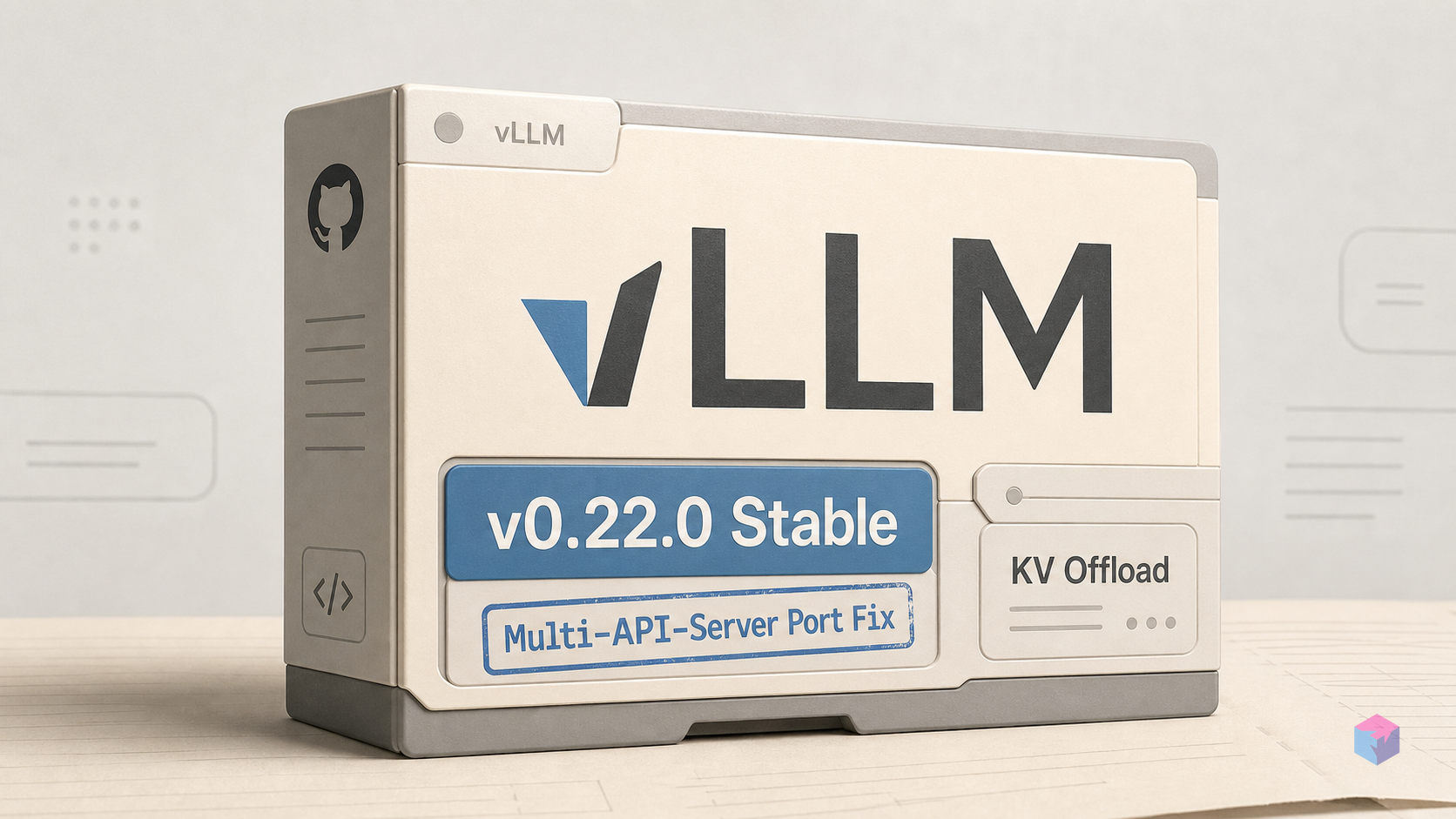
" target="_blank" rel="noopener noreferrer">issue #39762 (filed April 14, 2026 ): multiple vLLM instances launched without --port route requests silently and randomly across instances. Root cause: with --api-server-count > 1, API server processes share a single socket by design. The gap is that no port-availability check occurs at server creation, so misconfigured deployments fail silently. PR #39777 proposes a pre-flight check; merge status unconfirmed as of May 29, 2026.
Does vLLM v0.21.0 fix speculative decoding for DeepSeek-R1?
Yes. Speculative decoding now correctly respects reasoning and thinking budget constraints. Prior to this fix, DeepSeek-R1 chain-of-thought inference produced incorrect outputs when budget limits were applied during spec decode. The release also adds the TOKENSPEED_MLA attention backend for further optimization of DeepSeek-R1 and Kimi-K25 on NVIDIA Blackwell GPUs.
What does the C++20 compiler requirement mean for vLLM v0.21.0?
You need gcc 10+ or clang 12+ to build from source or compile custom extensions. Pre-built wheels from PyPI handle this internally, so a standard pip install vllm==0.21.0 is unaffected. Any custom build environment — CI containers, older Docker base images, Dockerfile-based installs — must be updated to a C++20-capable compiler before the build proceeds.
Do I have to upgrade to HuggingFace Transformers v5 for vLLM v0.21.0?
Yes — it is a hard requirement. Transformers v4 is deprecated in this release; transformers>=5 is mandatory. Before upgrading in production, run a full model-load smoke test against every fine-tuned checkpoint your service uses. Some v4-era tokenizer configurations are not forward-compatible and will need remediation before promotion.
What to Watch Next
Two signals matter in the near term. First, the merge status of PR #39777: if it lands in a v0.21.x patch, multi-server port behavior becomes safe to rely on without manual mitigation. Watch the releases page for a changelog entry that explicitly references the fix. Second, the bi-weekly cadence places v0.22.0 plausibly in early June 2026 — but until a tag appears on GitHub or PyPI, v0.21.0 is the only production-safe target.
For teams on v0.20.x, the speculative decoding correction and HMA integration are the primary reasons to upgrade now rather than waiting. KV offload unlocks longer effective context without hardware changes, but benchmark host DRAM tail latency before any SLA commitment. Treat the Transformers v5 migration as a prerequisite gate — verify checkpoints first, upgrade second.
Last updated: 2026-05-29. Based on the vLLM GitHub releases page, PyPI index, and GitHub issue tracker as of May 29, 2026.