

vLLM tagged v0.22.0rc3 at 07:11 UTC on May 28, 2026 — three release candidates in under 48 hours. Each RC fixes a different failure mode in the multi-API-server startup path. The pattern is worth understanding before you deploy.
What Changed in RC3 (and Why RC1 and RC2 Weren't Enough)
RC3 carries exactly one fix: PR #43768 replaces a hard-coded 60-second startup timeout in the multi-API-server coordinator with a configurable environment variable, VLLM_ENGINE_READY_TIMEOUT_S . The tag was pushed by maintainer @vadiklyutiy (Vadim Gimpelson), co-authored by Nick Hill, according to the vLLM GitHub tags page .
VLLM_ENGINE_READY_TIMEOUT_S. Set it to 120–300s in environments with slow or rate-limited HuggingFace Hub access. RC1 and RC2 each addressed separate regressions on May 27.
The two prior RCs addressed different problems. RC1 (May 27) fixed a KV connector edge case in speculative-decode scenarios under Model Runner V2 — PR #43719, tagged by @njhill . RC2 (May 27) patched an early CUDA initialization regression — PR #43791, tagged by @hmellor . None of the three RCs touch the same subsystem, which means the multi-API-server startup path is exercising code paths that CI had not previously stressed.
| RC | Tagged | PR | Subsystem | Fix Summary |
|---|---|---|---|---|
| RC1 | May 27, 2026 | #43719 | KV Connector / Speculative Decode (MRV2) | Edge case fix in KV connector under MRV2 speculative decode path |
| RC2 | May 27, 2026 | #43791 | CUDA Initialization | Fixed early CUDA init regression introduced in the RC cycle |
| RC3 | May 28, 2026 | #43768 | Multi-API-Server Coordinator Timeout | Replaced hard-coded 60s startup timeout with VLLM_ENGINE_READY_TIMEOUT_S |
Three distinct regressions across three RCs in under 48 hours is a signal, not noise. The multi-API-server deployment mode is new surface area, and the RC cycle is doing what it should: surfacing boundary conditions before stable. If you are evaluating v0.22.0 for production, RC3 is the one to test against — but track the releases page for a possible RC4.
The Root Cause: HuggingFace Hub Backoff vs. ZMQ Address Discovery

The 60-second timeout was not arbitrary, but it assumed local or fast model access. During multi-API-server startup, each server process must discover and register its ZMQ socket address with the DP Coordinator. That registration must complete before the Coordinator considers the cluster ready. The problem surfaces when HuggingFace Hub lookups hit rate-limiting and trigger retry backoff — a routine occurrence in large-scale deployments pulling models across many nodes simultaneously .
When address discovery exceeds 60 seconds, the Coordinator declares startup failed and the process exits — even though the API servers will eventually complete registration. The cluster never enters serving state. From an operator's perspective, this looks like an opaque startup crash with no clear indication that the fix is a timeout adjustment rather than a configuration error.
The fix externalizes the timeout entirely. Setting VLLM_ENGINE_READY_TIMEOUT_S=120 gives each server process twice the default window; 180–300s is appropriate for clusters with restricted Hub access or high retry backoff. The PR #43768 description documents the variable and its semantics . For deployments using fully local model caches (no Hub egress), the original 60s is likely never hit — but setting the variable explicitly is low-cost insurance.
The deeper issue is that ZMQ address registration happens serially per server process, and the Hub backoff window is non-deterministic. Until vLLM separates model-weight loading from address registration — or surfaces the timeout as a first-class config flag in the deployment docs — operators need to be aware that this env var exists and set it proactively.
How the Multi-API-Server Architecture Works
The --api-server-count flag scales vLLM's HTTP frontend layer independently from the engine tier. Despite running multiple API server processes internally, callers see a single HTTP endpoint. The vLLM data-parallel deployment docs describe three routing configurations, each placing request-routing logic in a different layer of the stack .
- Internal mode: A single endpoint with built-in queue-depth scheduling. vLLM manages load balancing itself. Suited for single-node or simple multi-GPU setups where you want no external dependencies.
- Hybrid mode: Per-node API servers each handle their own node's traffic, backed by an upstream load balancer you control. Useful when you have an existing LB layer but want per-node vLLM processes.
- External mode: Each DP rank runs as a fully independent endpoint. Kubernetes Services and Ingress handle routing natively. The correct choice when your cluster already has a routing layer and you need per-rank observability.
The DP Coordinator is the process that ties this together. It synchronizes forward passes across data-parallel ranks — and for Mixture-of-Experts (MoE) models, it enforces dummy forward passes on idle ranks at each step. This keeps expert-layer weights coherent across all nodes, preventing divergence in the expert routing tables that MoE architectures maintain per-rank . The Coordinator is not a separately deployed service — vLLM starts it automatically when DP > 1.
Frontend-to-engine communication uses ZMQ sockets. At startup, each API server process resolves its engine's ZMQ address and registers it with the Coordinator. This is the registration step where RC3's timeout was triggered: if Hub lookups delay process initialization past the deadline, registration never completes. In VPC-isolated cloud environments, you'll also need explicit firewall rules allowing ZMQ traffic between API server and engine nodes — this is not documented prominently but is required for multi-node deployments.
| Mode | Who routes requests | Best for | Kubernetes-native? |
|---|---|---|---|
| Internal | vLLM (queue-depth scheduler) | Single-node, simple setups | No |
| Hybrid | Per-node vLLM + external LB | Multi-node with existing LB | Partial |
| External | Kubernetes Services / Ingress | Cloud-native, per-rank routing | Yes |
Model Runner V2: The Architectural Backdrop
Model Runner V2 (MRV2) is the execution-core rewrite that underpins both RC1's KV connector fix and the broader v0.22.x cycle. Announced in a March 24, 2026 blog post, MRV2 is a ground-up reimplementation of vLLM's model runner — the component that schedules and executes forward passes on GPU .
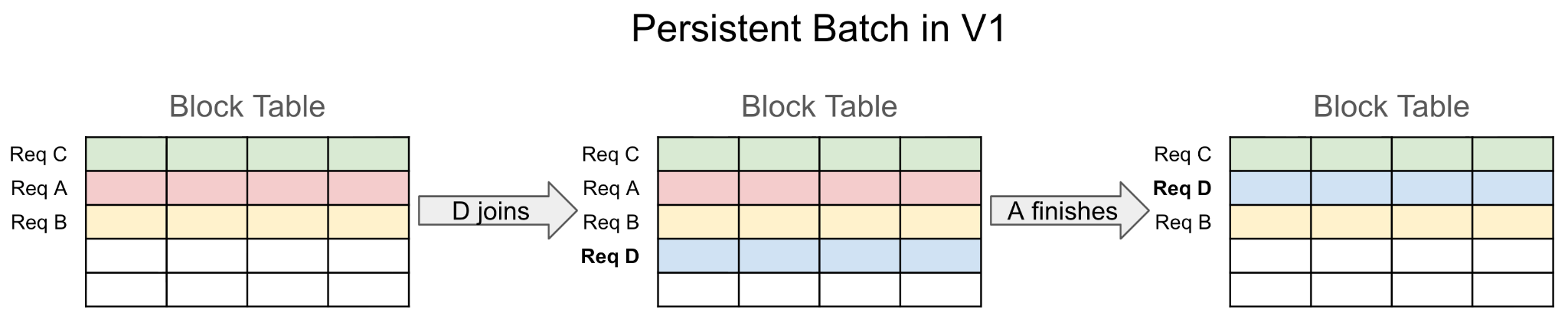
Key changes relative to V1: persistent state tensors are decoupled from the forward-pass graph; input metadata preparation moves to GPU-native Triton kernels rather than CPU preprocessing; scheduling is async-first with no CPU-GPU synchronization barriers; and a StagedWriteTensor abstraction handles efficient tensor diffing between steps. Together, these eliminate the primary sources of per-step CPU overhead that constrained V1 throughput at high concurrency.
The numbers from the blog post are concrete: on a GB200 GPU running Qwen3-0.6B, MRV2 achieved 25K output tokens/sec versus 16K for V1 — a 56% throughput gain . Speculative decoding Time Per Output Token (TPOT) improved 6.3% with GLM-4.7-FP8 on the same hardware . These are not cherry-picked configurations — GB200 is a realistic target for teams running large DP deployments, which makes the multi-API-server + MRV2 combination the actual production scenario v0.22.0 is targeting.
As of RC3, MRV2 still requires opt-in via VLLM_USE_V2_MODEL_RUNNER=1. Whether v0.22.0 stable promotes MRV2 to default has not been confirmed in public release notes . If it does, the env var becomes redundant — and keeping it set after promotion is harmless but worth cleaning up to avoid confusion in your deployment manifests. Watch the stable release notes before finalizing your env configuration.
What v0.22.0 Means vs. v0.21.0: Release Delta
v0.21.0 shipped May 15, 2026 with 367 commits from 202 contributors . Its headline additions were infrastructure-level: the Hybrid Memory Allocator (HMA) for KV cache offloading to CPU/host memory, NIXL 1.x support for bi-directional disaggregated KV transfers, MooncakeStoreConnector for distributed KV offloading across nodes, speculative decoding with reasoning budget constraints, and RayExecutorV2 promoted to default for DP > 1 deployments. Two breaking changes: C++20 compiler required (up from C++17), and Transformers v4 is deprecated as a backend .
v0.22.0's headline is different in kind: it makes multi-API-server distributed inference a first-class deployment mode rather than an experimental flag. The RC cycle is stabilizing the startup path for that mode specifically. The full feature set beyond the three RC patches has not been disclosed — the RC cycle started May 27 and no comprehensive release note thread has been published as of RC3.
| Release | Date | Commits / Contributors | Headline Feature | Breaking Changes |
|---|---|---|---|---|
| v0.21.0 | May 15, 2026 | 367 commits, 202 contributors | HMA KV offload, NIXL 1.x, MooncakeStoreConnector, RayExecutorV2 default | C++20 required; Transformers v4 deprecated |
| v0.22.0 | ~late May 2026 (RC phase) | TBD | Multi-API-server distributed inference as first-class mode | TBD — stable notes pending |
The cadence is consistent: v0.18.0 shipped March 20, v0.21.0 on May 15, and v0.22.0 is targeting late May — roughly bi-weekly major releases . For teams tracking upgrades, that pace means you have about two weeks between stable releases to validate your deployment against the new version. The RC cycle is your window to test before stable lands.
Action Items for Operators Running DP Deployments
If you run --api-server-count > 1 in any environment where HuggingFace Hub access is slow, rate-limited, or goes through a proxy, set VLLM_ENGINE_READY_TIMEOUT_S before your next deployment. The right value depends on your Hub access latency: 120s covers most cases; 180–300s is appropriate for air-gapped clusters pulling through a mirror or heavily throttled corporate networks. For deployments using fully local model caches with no Hub egress, 60–90s is likely sufficient.
If you are currently running RC1 or RC2, upgrade to RC3 before stress-testing speculative decode or any CUDA-heavy startup path. RC2's CUDA init regression is specific to startup sequences with certain GPU configurations, and RC1's KV connector fix is required for speculative decode correctness under MRV2. Running RC3 gets you all three fixes.
For your load-balancing mode choice: if you are on Kubernetes with existing Ingress controllers, use External mode. Internal mode is the right default for single-node setups. Hybrid is the transition mode for teams that have an external LB but haven't yet moved to per-rank Kubernetes Services. Validate your choice against the vLLM data-parallel deployment documentation before deploying to production .
Track the v0.22.0 stable release notes specifically for the MRV2 default-promotion decision. If MRV2 becomes the default runner, VLLM_USE_V2_MODEL_RUNNER=1 in your env becomes a no-op — not harmful, but it signals that your deployment config is stale. Clean it up when stable ships.
Frequently Asked Questions
What does VLLM_ENGINE_READY_TIMEOUT_S do and what should I set it to?
VLLM_ENGINE_READY_TIMEOUT_S controls how long the DP Coordinator waits for each API server process to register its ZMQ socket address at startup. Before RC3, this was hard-coded at 60 seconds — sufficient for fast local model access, but not for environments where HuggingFace Hub rate-limiting triggers retry backoff. Set it to 120–300s if your cluster has slow or throttled Hub access. For deployments using fully local model caches with no Hub egress, 60–90s is typically sufficient. The variable is read at process start and applies per-server, not as a global cluster timeout.
Is the multi-API-server feature stable enough for production in v0.22.0?
The feature is functional — the three RC issues were startup-timing and CUDA initialization regressions, not correctness bugs in request handling or output generation. That said, three RCs in 48 hours indicates the startup path has non-trivial sensitivity to environment conditions (Hub latency, CUDA driver state, ZMQ socket timing). Treat it as production-ready with a cautious rollout: set VLLM_ENGINE_READY_TIMEOUT_S explicitly, validate startup behavior in your target environment before cutting over traffic, and test the specific load-balancing mode you plan to use. A fourth RC is possible before stable is tagged, per the vLLM releases page.
What is the DP Coordinator and do I need to run it separately?
The DP Coordinator is a vLLM-managed process that synchronizes forward passes across data-parallel ranks. You do not deploy it separately — vLLM starts it automatically when DP > 1. Its primary job is ensuring that all ranks step through forward passes in lockstep. For Mixture-of-Experts models specifically, it enforces dummy forward passes on idle ranks at each step, keeping expert-layer weights coherent across nodes. Without this synchronization, expert routing tables can diverge between ranks, causing non-deterministic output or model errors. All of this is internal to the vLLM process group; no additional infrastructure is required.
Which load-balancing mode should I use with Kubernetes?
Use External mode. In External mode, each DP rank runs as an independent HTTP endpoint, which maps directly to a Kubernetes Service. Your Ingress controller or Gateway API routes traffic to ranks natively, giving you per-rank health checks, circuit breaking, and observability through standard Kubernetes tooling. Internal mode is designed for single-node deployments where vLLM manages scheduling itself — it does not expose per-rank endpoints for Kubernetes to route to. Hybrid mode sits between the two: per-node API servers with an external load balancer, suitable if you have a non-Kubernetes LB layer in front of your cluster. Details in the vLLM data-parallel deployment docs.
Is Model Runner V2 (MRV2) the default in v0.22.0?
Not confirmed as of RC3. As of the March 24, 2026 MRV2 announcement, enabling it required opting in via VLLM_USE_V2_MODEL_RUNNER=1. The v0.22.0 stable release notes may promote it to default, but no such confirmation appears in the RC notes published through May 28. Watch the stable release thread before finalizing your deployment environment. If MRV2 is promoted to default, the env var becomes a no-op — existing deployments with the override set will still work, but the variable should be removed from manifests to avoid confusion during future debugging.
What to Watch Before v0.22.0 Stable
RC3 closes the most operator-visible startup regression in the multi-API-server path. The configurable timeout is a meaningful improvement over a hard-coded limit that had no escape hatch. But the open questions still matter before you commit to a production rollout: whether MRV2 becomes the default runner, whether --api-server-count officially covers multi-node distribution (not just same-node scaling), and whether any new model architectures or quantization backends are added in the stable cut.
The vLLM releases page is the right place to watch. The project has held a roughly bi-weekly cadence, so stable should arrive within days of this RC. In the meantime, if you are building or validating a multi-API-server deployment now, RC3 is a reasonable test target — with VLLM_ENGINE_READY_TIMEOUT_S set explicitly and External mode selected if you are on Kubernetes.
Last updated: 2026-05-28. Based on the v0.22.0rc3 tag, PR #43768, and the vLLM data-parallel deployment documentation current as of this date. Reviewed against the vLLM GitHub tags page, releases page, and vLLM blog.

