What Robinhood Actually Shipped on May 27
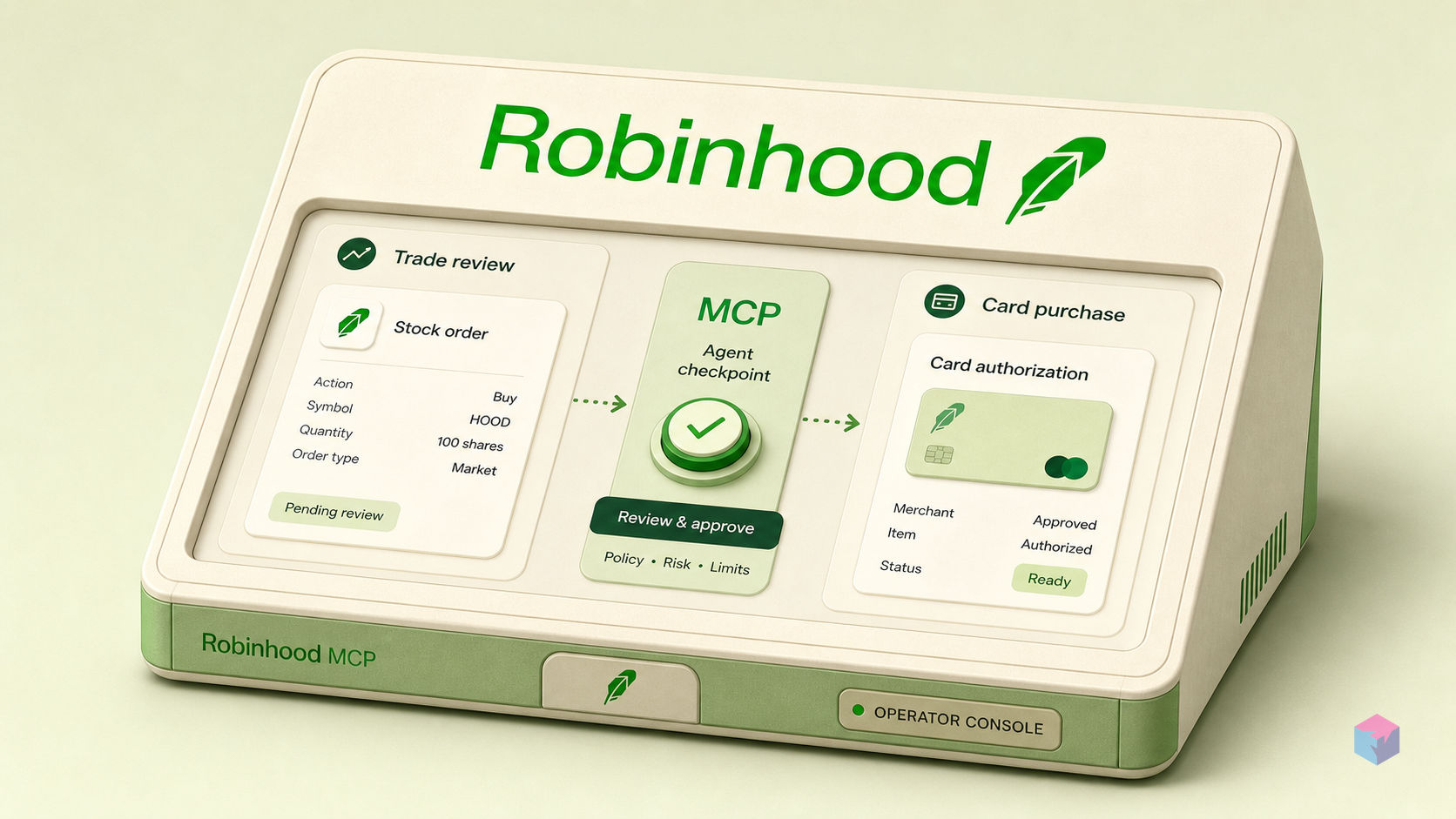
On May 27, 2026, Robinhood launched two distinct products built on Model Context Protocol (MCP) server infrastructure: Agentic Trading, enabling AI agents to execute securities trades in a dedicated isolated brokerage account, and the Agentic Credit Card, letting agents make card purchases within user-defined limits from a virtual card separate from the primary Gold Card. According to CNBC, this makes Robinhood the first major U.S. retail brokerage to offer officially sanctioned, AI-initiated securities trading to ordinary investors .
The Agentic Trading beta is limited to equities and is accessible to Robinhood's 27 million funded customers . The Agentic Credit Card is gated at launch to approximately 700,000 existing Robinhood Gold cardholders , with Platinum Card support on the roadmap. Future phases of Agentic Trading are planned to cover options, cryptocurrency, event contracts, futures, and prediction markets.
Prior to this launch, retail investors who wanted to automate trading needed custom integrations or unofficial API workarounds. Robinhood's approach provides what it calls "direct, sanctioned access" — an official integration layer that any MCP-compatible agent can use without Robinhood-specific engineering. TechCrunch characterized it as a "bring your own agent" model: no single AI client is required or preferred . The two-product structure — spanning brokerage and banking — reflects that Robinhood built MCP servers across both business lines, not only its trading platform.
Product VP Abhishek Fatehpuria stated the company is deliberately targeting early adopters to gather learning before scaling. The staged rollout — equities only for trading, existing Gold cardholders only for the card — follows a pattern consistent with regulated-product betas: constrain scope, observe behavior, expand from a stable baseline.
"Our mission has always been to democratize finance for all, and now, that mission extends to AI agents." — Vlad Tenev, CEO at Robinhood (Fortune, May 2026).
MCP as the Plumbing: What the Server Exposes

Model Context Protocol (MCP) is an open standard for connecting AI agents to external services through defined tool endpoints. Robinhood built separate MCP servers for its brokerage and banking platforms: the brokerage server exposes tools for trade execution, portfolio analysis, P&L queries, sector concentration review, and analyst note access . The banking server exposes card spending controls and purchase authorization endpoints. An agent calling these tools operates within the permissions scoped to the user's agentic account — it cannot access the user's primary portfolio or primary card number within the same session.
Confirmed compatible clients at launch include Claude (Anthropic), ChatGPT (OpenAI), Codex, Codex CLI, and Cursor. Any agent framework that implements the MCP specification can connect — Robinhood does not maintain an approved-agent list or restrict access to particular AI providers . For teams already shipping agents with the Anthropic SDK, LangGraph, or a custom MCP client implementation, those pipelines can point at Robinhood's MCP server endpoint with no additional vendor-specific integration work.
The tool surface is a scoped API wrapped in MCP semantics. When an agent calls a trade execution tool, the underlying request routes through Robinhood's order management system with full compliance logging, circuit-breaker protections, and the same settlement infrastructure used for manual trades. The MCP layer adds natural-language parameter parsing and the standardized tool-calling interface — it does not bypass back-end risk controls. The separation is architecturally important: the guardrails live in Robinhood's infrastructure, not in the agent's prompt or the MCP wrapper.
Robinhood joins Stripe, Visa, and AWS Bedrock in opening financial infrastructure to AI agents via MCP or closely compatible protocols . The emerging pattern suggests agentic finance tools — a portfolio rebalancing function, a conditional-purchase function — may be converging toward platform-independent building blocks. An agent tool written against Robinhood's rebalancing endpoint today may need only a configuration change to work with a different MCP-enabled brokerage that ships a compatible interface. Whether the tool schemas across providers converge on shared semantics or diverge into incompatible namespaces that require per-provider adapters remains the open question.
The "bring your own agent" design has a strategic implication worth noting for builders: Robinhood is positioning its competitive advantage as data quality, order routing, and execution fill rates rather than a bundled AI assistant. This mirrors how cloud infrastructure platforms handled the API economy — open the interface, compete on the underlying service. For teams building on this infrastructure, it also means that if a competing brokerage ships equivalent MCP endpoints, migrating an agent's toolchain becomes a configuration update rather than a full re-integration effort.
Agentic Trading: Account Isolation and Guardrails
Agentic Trading is built around a dedicated isolated account model: users create a separate agentic trading account, fund it explicitly with only the capital they choose to expose, and the primary portfolio remains completely unaffected by any agent action . The agent cannot read or write to the primary portfolio from the agentic account session. This account isolation is the primary architectural risk control — it constrains any misconfigured instruction or agent error to the explicitly allocated capital.
Within the equities beta, the agent can execute: portfolio rebalancing toward target weightings, sector concentration analysis to surface over- or under-exposure, conditional and mean-reversion execution based on price thresholds or statistical signals, and analyst note review to generate trade candidates. Future additions — options, cryptocurrency, event contracts, futures, and prediction markets — are planned but not available at launch.
Robinhood publishes an explicit product disclosure: "AI agents can make errors, misinterpret instructions, and behave unexpectedly." Ongoing monitoring responsibility rests with the customer, not the platform or AI provider . This is a meaningful liability posture — users enabling Agentic Trading are accepting that agent errors are within the normal scope of use, and that it is their responsibility to review activity and intervene when needed.
| Control | What It Does | User Action Required |
|---|---|---|
| Real-time activity feed | Continuous log of all agent actions and trade events in the agentic account | Monitor dashboard |
| P&L dashboard | Live profit/loss view for the agentic account, isolated from the primary portfolio | Passive review |
| Push notification per trade | Push alert sent to the user's device each time a trade executes | None (automatic) |
| Trade preview toggle | Optional mode: agent proposes trade, user approves before submission is sent | Enable in settings; approve each trade |
| Manual disconnect | Immediate revocation of agent access to the trading account | Tap disconnect in app or dashboard |
| Account isolation | Primary portfolio is inaccessible to the agent; agent operates only on the funded agentic account | Fund the agentic account explicitly |
"AI agents can make errors, misinterpret instructions, and behave unexpectedly." — Robinhood product disclosure, as reported by Decrypt (May 2026). Monitoring responsibility stays with the customer.
The trade preview toggle is the most consequential control for most users. With preview enabled, the agent proposes a trade and the user confirms before submission — converting the setup from fully autonomous to human-in-the-loop. This is not the default configuration. Builders shipping applications on top of this infrastructure should either enforce preview mode by default or communicate the autonomous-execution default explicitly and prominently during user onboarding. The gap between "I told the agent to rebalance" and "the agent executed seventeen trades while I slept" is bridged only by the preview toggle or the activity feed.
Agentic Credit Card: Virtual Card Isolation and Spending Controls

The Agentic Credit Card issues a virtual card number distinct from the customer's primary Robinhood Gold Card. The AI agent is scoped exclusively to the virtual card — it has no access to the primary card number or broader account details . This mirrors the agentic trading account isolation: the boundary between the agent's operating surface and the primary financial account is enforced at Robinhood's infrastructure level, not solely in the application logic.
The feature is available at launch to approximately 700,000 existing Robinhood Gold cardholders , with Platinum Card support planned. Cash back on the Agentic Card matches the standard Gold Card rate at 3% — users do not sacrifice rewards when routing purchases through an agent.
| Feature | Detail | Default State |
|---|---|---|
| Virtual card isolation | Separate card number from primary Gold Card; agent cannot access primary card or account details | Always enforced |
| Per-transaction spending limit | Maximum spend per individual agent-initiated transaction | User-configured |
| Monthly spending cap | Hard ceiling on total agent-initiated spend per calendar month | User-configured |
| Manual approval toggle | Each purchase requires explicit human sign-off before processing | Off (opt-in) |
| Cash back rate | 3% on purchases, matching Gold Card rate | Always applied |
| Launch eligibility | Existing Robinhood Gold cardholders (~700,000); Platinum Card support planned | Gold required |
Use cases demonstrated at launch illustrate the range of tasks the system handles: buying a product only if its price drops below a user-specified threshold, automatically scanning for price changes before committing a purchase, booking reservations, and executing domain name registrations. These are narrow, well-defined transaction types with clear success conditions — an appropriate initial scope. Natural-language agent flexibility is most reliable when tasks have unambiguous termination states ("buy this if price ≤ $X") rather than open-ended spending authority.
The manual approval toggle warrants specific attention for builders designing consumer-facing applications. Unlike the trading preview toggle — which pauses the agent before trade submission — the card approval toggle is a per-purchase human gate. This design accommodates users who want agent-assisted purchase discovery ("scan and propose purchases matching my criteria") without granting autonomous execution authority. Surfacing the toggle prominently in onboarding helps users select the risk profile that matches their intent.
Connecting to Robinhood's MCP Server: What Builders Need to Know
Robinhood's MCP servers require no custom SDK, no proprietary API wrapper, and no Robinhood-specific integration layer. Standard MCP client configuration in any compatible framework is sufficient . If your agent framework already implements MCP — Claude with tool use, OpenAI's function-calling pipeline, Cursor's agent mode, or a custom implementation built on Anthropic's MCP specification — you configure it with Robinhood's server endpoint and complete the OAuth authorization flow. No Robinhood developer documentation beyond the standard product setup flow was announced at launch.
Authorization is OAuth-based. The MCP session is tied to a specific Robinhood user account with scoped permissions defined at account creation time. For the trading product, scope is constrained to the dedicated agentic account the user funded. For the card product, scope is constrained to the virtual card with the user-configured spending limits. Agents cannot escalate beyond provisioned limits during an active session — the scoping is enforced at Robinhood's infrastructure layer, not in the agent's prompt or system instructions.
For a builder configuring the integration, the practical sequence is:
- The user creates a dedicated agentic trading account (or activates the agentic virtual card) in the Robinhood app and funds or configures it.
- The user completes the OAuth authorization flow, tying the MCP session to their Robinhood account with the scoped permissions from step 1.
- The developer configures the MCP client in their agent framework with the server endpoint and the user's OAuth token.
- The agent can now call brokerage or card tool endpoints within the authorized scope — no further Robinhood-specific steps are required.
No public Robinhood SDK has been announced, which is consistent with the "bring your own agent" positioning — Robinhood exposes an interface, not a library. For teams using a mature MCP client implementation, onboarding is minimal. For teams newer to MCP, the Anthropic MCP documentation is the most directly applicable reference: confirmed Claude compatibility implies Robinhood's server aligns with Anthropic's MCP specification. Early builder community write-ups provide hands-on context for the integration flow before official documentation expands.
Risk Surface: Where This Can Break
Prompt injection is the highest-severity risk in any configuration where an AI agent holds live credentials. If an agent with access to Robinhood's trading MCP server processes content from an untrusted source — a web page, an external document, an email — a maliciously crafted instruction embedded in that content could attempt to trigger a trade or card purchase. Robinhood has not published specific mitigations at the MCP layer as of the launch date . Builders shipping applications on this infrastructure need to implement their own input sanitization, context isolation between trusted and untrusted content, and principle-of-least-privilege patterns at the application layer. The brokerage layer will not catch an injected trade instruction — it will execute it.
Agent hallucination is the second meaningful threat vector. A natural-language instruction like "rebalance toward tech stocks" has multiple valid interpretations. If the agent parses the instruction incorrectly — wrong allocation target, wrong ticker, wrong direction — the trade executes before the user reviews the result, unless preview mode is active. Preview mode is the primary mitigation, but it is not the default configuration. Application design should either enforce preview mode for all users by default or make the autonomous-execution behavior explicit and prominent in onboarding. The operational question isn't whether the agent will occasionally misparse an instruction — it will — but whether users will be in a position to catch it before execution.
Regulatory exposure is the third dimension. The legal status of AI-initiated discretionary trading under SEC and FINRA rules is unsettled. Those rules were written with a human advisor as the decision-making layer; they do not address LLM inference explicitly. As of the May 27, 2026 announcement, neither the SEC nor FINRA had issued public statements on oversight requirements for agentic retail trading. Coastal Community Bank and Visa declined to comment on how agent-initiated transactions will be verified or who bears liability when an agent misinterprets customer intent .
"This is a wake-up call for the bankers." — Richard Crone, industry consultant, quoted in American Banker (May 2026). Crone warned that traditional banks, which have offered only "ledgers, statements, alerts and account aggregation," are now exposed to the automation layer Robinhood is providing directly to retail customers.
Account isolation limits the blast radius of an error but does not eliminate it. A misconfigured spending cap, an ambiguous instruction processed without preview, or an agent iterating aggressively on a mean-reversion signal can exhaust the funded agentic account within the allocated capital. For builders: treat the agentic account balance as an explicit exposure budget. Applications should surface the current balance prominently and keep the manual disconnect control accessible at all times — not buried in a settings panel three taps deep.
Broader Pattern: Finance Infrastructure Converging on MCP

Robinhood's launch adds a retail brokerage data point to a convergence pattern already visible across financial services. Stripe, Visa, and AWS Bedrock have opened payment and financial infrastructure to AI agents via MCP or closely compatible protocols over the past 12 months . The convergence matters because it shifts agentic finance tooling from one-off integrations toward something closer to a shared interface standard — composable across providers rather than rebuilt for each.
For builders, the practical implication is toolchain portability. An agent tool that rebalances a Robinhood portfolio is written against an MCP tool schema. If a different broker ships a compatible MCP server with matching tool names and parameter shapes, that agent tool requires a configuration change rather than a full rewrite. This mirrors the same value proposition MCP offers in other domains — code execution, database access, web search — applied now to regulated financial operations. The open question is whether tool schemas across financial providers converge on shared semantics or diverge into incompatible namespaces that require per-provider adapters anyway.
The "bring your own agent" framing signals a structural shift in how financial platforms compete. Historically, brokerages built proprietary AI surfaces — robo-advisors, in-app chatbots — as differentiated product features. Robinhood's model inverts this: the platform exposes infrastructure, and competition happens on data quality, order routing, and execution fill rates. For builders, this means the agent toolchain is portable in principle; the remaining competitive moat is the underlying financial service quality. According to Yahoo Finance, KeyBanc analysts described the products as "significant" for Robinhood's growth trajectory , though the regulatory pathway is the more consequential variable.
Robinhood's implementation establishes early precedents for regulated-industry MCP adoption: scoped accounts as the isolation primitive, mandatory disclosure language in consumer-facing onboarding, and customer-borne monitoring responsibility as the default liability posture. Other regulated industries — insurance, healthcare, lending — will face the same questions when they move AI agents into operational roles. Whether financial regulators formalize these design patterns into requirements, or push back with more restrictive frameworks, will shape how the next wave of agentic finance integrations is architected.
Frequently Asked Questions
Which AI agents can connect to Robinhood's MCP server?
Any MCP-compatible client can connect. Robinhood confirmed support at launch for Claude (Anthropic), ChatGPT (OpenAI), Codex, Codex CLI, and Cursor. There is no single required or preferred agent — Robinhood uses a "bring your own agent" model. Any framework implementing the Model Context Protocol specification can be configured to use Robinhood's brokerage or banking MCP server endpoints without a custom Robinhood-specific integration layer.
Is the agentic trading account separate from my main Robinhood portfolio?
Yes. Users create a dedicated agentic trading account and fund it separately from their primary portfolio. The agent has no access to the primary portfolio — account isolation is enforced at Robinhood's infrastructure level, not just at the application layer. Any trades or errors in the agentic account are contained within the capital explicitly allocated to it. The primary portfolio is unaffected by all agent activity.
How does the Agentic Credit Card prevent unauthorized spending?
The Agentic Credit Card is a virtual card with a distinct number from the customer's primary Robinhood Gold Card. The agent cannot access the primary card number or broader account details. Users configure per-transaction spending limits and monthly caps at setup time. An optional manual-approval toggle can require explicit human sign-off before each agent-initiated purchase is processed. These controls are enforced at Robinhood's infrastructure layer — agents cannot exceed provisioned limits regardless of the instructions they receive during a session.
Who is legally responsible if the AI agent makes a bad trade?
Robinhood's product disclosure places monitoring responsibility on the customer. The company explicitly states that AI agents can make errors, misinterpret instructions, and behave unexpectedly, and that users are responsible for ongoing oversight and intervention. Regulatory clarity on AI-initiated discretionary trading under SEC and FINRA rules remains unsettled as of the May 27, 2026 launch — neither agency had issued guidance on agentic retail trading by the announcement date. The legal accountability framework for disputed AI-executed trades is an open and unresolved question.
Do I need to build a custom Robinhood integration to use these features?
No. Standard MCP client configuration in any compatible framework is sufficient. Robinhood has not announced a custom SDK. You configure your agent's MCP client with Robinhood's server endpoint and complete the OAuth authorization flow that scopes the session to the user's Robinhood account and its provisioned permissions. The MCP documentation from Anthropic, OpenAI, or Cursor applies directly. Robinhood's MCP server handles all brokerage and card API logic at the back end; the agent sees only the tool interface.
What to Watch Next
Robinhood's expansion roadmap is clearly staged. Options, cryptocurrency, event contracts, futures, and prediction markets are all planned additions to Agentic Trading. Each expansion increases the scope of what an agent can touch and brings higher-stakes execution risk — options in particular carry leverage exposure that makes a misinterpreted instruction significantly more costly than the same error in equity rebalancing. Watch the product disclosure language change as these categories roll out, since the current framing of "customer-borne monitoring responsibility" may need refinement when leverage is in scope.
The more significant near-term questions are regulatory and competitive. The SEC and FINRA have not yet addressed agentic retail trading in public guidance. When they do, requirements will likely retroactively shape what the current Robinhood implementation is permitted to allow — and whether the customer-monitoring model is a compliant liability posture under existing discretionary trading rules. On the competitive front, the question is whether Schwab, Fidelity, and Interactive Brokers ship MCP-compatible infrastructure with converging tool schemas, or build incompatible interfaces that fragment the agentic finance toolchain for the foreseeable future.
For builders, the most actionable near-term signal will come from teams who have deployed agents on Robinhood's infrastructure in production: what prompt injection defenses they implemented at the application layer, how they handled edge cases in natural-language instruction parsing, and what the real-world error rate of misinterpreted trade instructions looks like under live conditions. The interface is available now; the operational knowledge base is still being built in the open.
Last updated: 2026-05-30. This article reflects information available at the time of Robinhood's May 27, 2026 product announcement. Regulatory status, product availability, and compatible agent frameworks may change as the beta expands.