
Meta One: What the Unified Subscription Brand Actually Covers
Meta One is Meta's unified subscription brand, announced on May 27, 2026 , that consolidates fragmented subscription experiments — including Meta Verified, per-app pilots, and now the company's first paid AI tiers — into a coherent product ladder spanning social apps and AI. The announcement covers five plan types: three social app subscriptions that launched globally on May 27, and two AI tiers (Plus at $7.99/month and Premium at $19.99/month ) entering limited testing in Singapore, Guatemala, and Bolivia in June 2026 . The free Meta AI tier remains intact across all surfaces.
The consolidation replaces a history of piecemeal experiments. Meta Verified, launched in 2023, was an identity and badge verification product with inconsistent cross-market pricing. Individual app subscriptions were tested quietly across Instagram, Facebook, and WhatsApp. Meta One packages those experiments into a single branded architecture with a defined tier ladder — eliminating the friction that multiple independent subscription names created for users and businesses trying to reason about their options .
The globally live social app layer covers three plans. Instagram Plus at $3.99/month includes story insights, custom audience lists, extended story duration, and profile customization. Facebook Plus at $3.99/month delivers similar customization perks. WhatsApp Plus at $2.99/month adds themes, pinned chats, premium stickers, and custom ringtones. These plans are live now, not test-market-gated.
Two business-focused tiers are in parallel testing. Meta One Essential at $14.99/month targets identity verification and fraud protection — the functional successor to Meta Verified. Meta One Advanced at $49.99/month is aimed at businesses and creators who need algorithmic visibility controls, analytics dashboards, team access, and automated tools. AI glasses integration for Ray-Ban Meta is described as an upcoming benefit tied to paid AI tiers, though specific features are not yet detailed .
| Plan | Price/mo | Availability Status | Primary Value |
|---|---|---|---|
| Free (Meta AI) | $0 | Global — live | Base AI access, throttled compute budget |
| WhatsApp Plus | $2.99 | Global — launched May 27, 2026 | Themes, pinned chats, premium stickers, custom ringtones |
| Instagram Plus | $3.99 | Global — launched May 27, 2026 | Story insights, custom audience lists, extended story duration |
| Facebook Plus | $3.99 | Global — launched May 27, 2026 | Profile and feed customization perks |
| Meta One Plus (AI) | $7.99 | Testing — SG, GT, BO (June 2026) | Higher AI compute capacity; image gen, video, extended reasoning |
| Meta One Essential | $14.99 | Testing | Identity verification, fraud protection |
| Meta One Premium (AI) | $19.99 | Testing — SG, GT, BO (June 2026) | Max compute ceiling; deep thinking mode, multi-step agentic tasks |
| Meta One Advanced | $49.99 | Testing | Algorithmic visibility, analytics, team access, automated tools |
AI Tier Mechanics: How Plus ($7.99) and Premium ($19.99) Actually Differ

The practical distinction between Meta One Plus and Meta One Premium is compute throughput, not a feature-flag split. Both tiers expose the same capability surface: expanded image generation, video creation tools, and extended AI reasoning. A Plus subscriber and a Premium subscriber see identical interface options. What changes is how much you can do per session and how complex the tasks can be before you hit the compute ceiling . Feature parity across tiers; infrastructure differentiation between them.
"[Our plans] give people who use Meta AI more to work with, more capacity, bigger, more complex requests, and more room to create for businesses and creators." — Naomi Gleit, Head of Product at Meta (source: TechCrunch)
Gleit's framing is precise: "capacity" and "more room to create" — not "new features." This positions the AI tiers as infrastructure differentiation rather than a traditional software feature-unlock model. The same architecture applies at Google's Gemini tiers: one model family, multiple compute lanes. Paying more buys a larger throughput bucket, not access to a fundamentally different model.
Meta has not published specific numerical limits as of the May 27 announcement. No token counts per session, image generation quotas, or video length caps have been disclosed . What is established is the qualitative structure: Meta One Premium unlocks a deeper "thinking mode" — an extended reasoning pathway for intensive multi-step problem solving — at a capacity ceiling that Plus does not reach. Free-tier users can access the same features but encounter the throttle faster and cannot sustain complex reasoning chains at the same depth or output volume.
Structurally, this mirrors how OpenAI runs ChatGPT Plus. There is no per-token billing or per-request pricing — capacity is a subscription bucket. You pay for a bucket size, not individual requests. For developers integrating Meta AI capabilities within WhatsApp or Instagram, this creates a runtime variable: a user's subscription tier determines how much throughput your feature can consume on their behalf during a session. An agent workflow embedded in WhatsApp that performs multi-step reasoning will behave differently depending on whether the end user is on free, Plus, or Premium tier. Application logic will need to account for that variance once hard quotas are published after the June 2026 test .
The absence of hard quota numbers during the current test period also means the behavior observed in the Singapore, Guatemala, and Bolivia rollout may not reflect final production limits. Treat the test phase as a signal for architecture decisions, not a source of firm API contract assumptions.
Llama Under the Hood: How Meta Gates Compute on Its Model Stack
Meta AI runs on the Llama model family. Subscription tiers do not change which model architecture is running — they gate how much inference compute is allocated to a given request. A free-tier user and a Premium subscriber are routed to the same underlying model family; the difference is the resource budget the inference infrastructure dedicates to their query, how long it sustains complex reasoning chains, and how large a context window it maintains . Weights are shared; compute is rationed.
The free tier operates on a throttled compute budget — either a per-session ceiling or a rolling time-window limit. For standard conversational usage, most users will not encounter the wall. It surfaces under generation-heavy workloads: long-form content production, generating multiple images in sequence, or running multi-step reasoning chains that iterate and self-correct. These are exactly the workloads that Plus and Premium are positioned to handle without interruption.
Premium tier routing likely uses one of two mechanisms, or a combination. Requests may be routed to higher-parameter model configurations within the Llama family — for example, a 70B or 405B variant instead of a smaller model assigned to free-tier requests. Alternatively, extended context budgets may be applied, giving the model a longer working memory window for complex task chains. Meta has not confirmed which Llama variant assignments apply per tier. The compute-routing architecture is consistent with how all major providers run multi-tier inference at scale: model weights are expensive to serve; routing differentiation at the inference layer is the practical implementation mechanism.
The Manus AI acquisition, closed in December 2025 at approximately $2 billion , is the likely source of Meta AI's current multi-step agentic capability. Manus AI was known for autonomous task-completion agents capable of browsing, writing, and executing multi-step workflows without constant user prompting. Those capabilities map directly to what Meta One Premium surfaces as "intensive multi-step problem solving at higher capacity ceilings" . The acquisition's integration is believed to have been absorbed into the current Meta AI product in the period since the deal closed.
The key developer distinction: open-weight Llama model downloads and the Llama API are separate from Meta One's consumer compute gating. If you self-host a Llama model, you run your own inference infrastructure — Meta One subscriptions are irrelevant to your deployment. If you use the Meta AI API directly, watch for policy changes that correlate API throughput to end-user subscription status. As of May 27, 2026, no such correlation has been stated . That remains the current baseline.
Pricing Comparison: Meta One vs ChatGPT Plus vs Google AI Pro
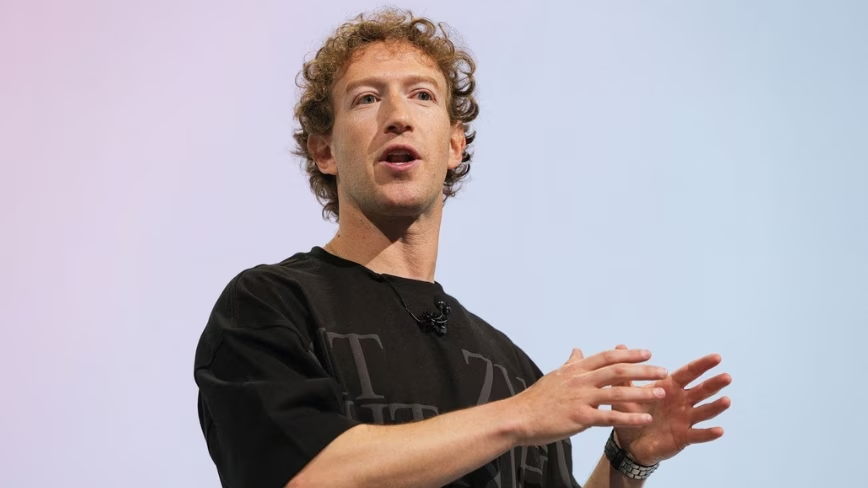
At $7.99/month, Meta One Plus undercuts ChatGPT Plus at $20/month by approximately 60% at the entry AI tier. This is deliberate: the target demographic is not existing ChatGPT or Gemini users who might switch products — it is the hundreds of millions of Meta social app users who have never paid for an AI subscription and would not start at $20/month. Meta One Premium at $19.99/month lands close to ChatGPT Plus on price , which changes the competitive framing entirely at the higher tier.
| Product | Entry AI Tier | Power User Tier | Business / Team Tier | Pricing Model | Distribution Surface |
|---|---|---|---|---|---|
| Meta One | $7.99/mo (Plus) | $19.99/mo (Premium) | $49.99/mo (Advanced) | Compute bucket | Embedded in WhatsApp, Instagram, Facebook |
| ChatGPT (OpenAI) | $20/mo (Plus) | — | Team plan (per user/mo) | Compute bucket | Standalone app + API |
| Google AI Pro | ~$20/mo | — | Google Workspace add-on | Compute bucket | Embedded in Google apps + standalone Gemini |
Meta One Advanced at $49.99/month targets a different use case than any OpenAI or Google equivalent. It bundles algorithmic visibility controls in the social feed, analytics dashboards, team access, and automated tools — capabilities specific to Meta's platform with no direct analog in standalone AI products. It is less a compete with ChatGPT's team offering and more a bundled business operating layer for users whose primary workflow surface is Facebook or Instagram.
The price architecture encodes a specific conversion hypothesis: the largest untapped AI subscriber pool is not existing ChatGPT or Gemini users — it is the billion-scale Meta app user base that has never paid for an AI product. Entering at $7.99/month lowers the barrier to a first-time AI payment transaction substantially. One acknowledged risk: anchoring entry-level AI subscription value at $7.99/month may complicate any upward pricing revision if inference costs require it . Consumer price anchors are durable once established.
For developers, the pricing comparison signals a market segmenting AI access by use context, not just by price. Meta AI in WhatsApp serves shorter, contextually social sessions with different session-depth patterns than a standalone coding assistant. Building for Meta AI means calibrating to those session-length assumptions and accepting a compute ceiling per interaction that reflects the embedded social use case — not a standalone power-user one .
The Embedded Distribution Advantage: 1 Billion MAU as the Conversion Pool
Meta AI reached approximately 1 billion monthly active users by mid-2025 — making it the largest potential subscriber conversion base of any AI product currently launching paid tiers. Users do not go to Meta AI; they are already in WhatsApp, Instagram, and Facebook, where Meta AI is embedded. Activation friction for a first subscription trial is near zero: the upgrade prompt appears inside an app the user opens dozens of times daily, with no separate download or account creation required.
This embedded placement is Meta One's primary structural differentiator — not model capability. Meta's Llama-based stack is competitive but not demonstrably superior to GPT-4o or Gemini 1.5 Pro across standard benchmarks. What Meta has at scale, that standalone AI products cannot replicate quickly, is frictionless placement inside the daily communication surface of a billion users. When Meta surfaces a subscription upsell, the user is mid-conversation in WhatsApp or mid-creation-flow in Instagram — the context is warm, not a cold acquisition moment .
"[Our plans] give people who use Meta AI more to work with, more capacity, bigger, more complex requests, and more room to create for businesses and creators," says Naomi Gleit, Head of Product at Meta. The "businesses and creators" framing identifies the highest-engagement, highest-session-depth segment in the MAU base — users already running substantive workflows inside Meta's apps who are most likely to hit free-tier compute limits and see value in upgrading.
The developer implication of this distribution model is concrete. If your application integrates Meta AI embedded features within WhatsApp or Instagram, a user's subscription tier becomes a runtime dependency for your feature's behavior. An agent workflow performing multi-turn reasoning in WhatsApp will encounter throttle limits faster for a free-tier user than for a Premium subscriber. Your application should be designed to degrade gracefully when compute ceiling signals appear. This pattern is already familiar to Telegram bot developers managing API rate limits — it is new territory specifically for Meta AI integrations, and it is worth engineering for now rather than retrofitting after global launch .
Revenue Strategy: Why Meta Is Making This Move Now
Meta derives roughly 97% of its revenue from advertising . That concentration is profitable at scale but structurally exposed: ad revenue tracks macroeconomic cycles and brand spending budgets. Subscription MRR is structurally more predictable and commands higher valuation multiples on public markets. The Meta One push is as much a capital markets argument as a product strategy — investors price recurring revenue differently than advertising revenue, and Meta's mounting AI infrastructure spend creates real pressure to diversify the revenue base.
The timing carries a defensive dimension. OpenAI has reportedly signaled intent to build a $100 billion/year advertising business , which would directly compete with Meta's core revenue model. Meta's response is a two-pronged hedge: introduce subscription revenue that diversifies away from ad dependency, while continuing to invest in AI-driven ad automation that makes Meta's advertising platform more effective and harder to displace. Subscriptions and ads are parallel tracks, not competing bets.
The Apple services pivot analogy is structurally accurate here. Apple used its installed iOS base to build a recurring services revenue stream — App Store, Apple Music, iCloud — that now commands a premium in its valuation model. Meta's logic is similar: a billion-plus daily-active user base provides the substrate for recurring revenue extraction at low marginal acquisition cost. The variable is willingness to pay. Meta's entry at $7.99/month — well below the $20/month that ChatGPT established as a market norm — reflects a realistic calibration of that threshold for a social app audience encountering a paid AI subscription for the first time .
At even modest conversion rates against the Meta AI MAU base, the subscription math becomes material. Converting 1% of approximately 1 billion MAUs to Plus at $7.99/month generates roughly $80M in monthly recurring revenue — before factoring in Premium and Advanced tier conversions. The test markets — Singapore as a high-income benchmark, Guatemala and Bolivia as middle-income and emerging-economy contexts — are specifically chosen to calibrate pricing elasticity across GDP tiers before any global pricing commitment is made .
What Developers Should Watch: API Access, Throughput Limits, and Open Weights

The most important developer-relevant fact about the Meta One announcement is what it does not say: Meta has made no announcement connecting Meta One subscription tiers to Llama API access or open-weight model downloads . If you are calling the Llama API today, your integration is unaffected. If you download Llama weights and self-host, you are running your own inference stack — Meta One subscriptions have no bearing on your deployment. Open-weight availability is a meaningful architectural escape hatch that the current announcement leaves fully intact.
The concern worth actively monitoring is whether compute-gating logic extends to the API layer over time. Precedent exists at every major provider: OpenAI introduced tiered rate limits on its API correlated with account spend; Anthropic gates certain Claude features behind tier-based access. If Meta applies similar logic — routing Llama API requests through a tier-aware inference layer that reflects end-user subscription status — then applications serving free-tier users could encounter different throughput characteristics than those serving Premium subscribers. This is speculative as of May 2026, but it is the natural trajectory once a provider has established a consumer compute-tier architecture and has strong incentives to extend it .
Meta One Advanced at $49.99/month is the tier most worth tracking for developer implications. Its automated tools and team access features are closer in function to a developer or business API access layer than to a standard consumer subscription. As Meta One matures past the June 2026 test markets, watch whether Advanced-tier benefits expand to include higher API rate limits, priority inference routing, or early access to model features. That expansion would signal Meta's entry into the territory currently occupied by OpenAI's higher API spend tiers — and would make Meta One Advanced the first developer-relevant pricing decision point in the stack.
Three specific items to track over the next six months:
- Quota documentation from the June 2026 test: Singapore, Guatemala, and Bolivia are the proving ground. Any published rate-limit or quota numbers from the test period will define the practical per-session ceiling for Meta AI integrations. This is the data you need to build against.
- Meta One Advanced API posture: If Meta adds explicit API throughput or rate-limit benefits to the Advanced tier, that is the inflection point where Meta One becomes a developer pricing story, not just a consumer subscription product.
- Llama API terms updates: Watch Meta's developer documentation for any changes to API terms of service that reference subscription tiers or usage routing logic. A quiet ToS update would be the first signal that compute gating is extending beyond the consumer product .
Self-hosted Llama remains the most developer-controlled option for teams that need predictable inference capacity, consistent context window behavior, and zero dependency on Meta's monetization roadmap. The open-weight model family is Meta's most significant contribution to the developer ecosystem, and that contribution is currently ring-fenced from the Meta One subscription architecture. That boundary is worth defending in any future API policy negotiations with Meta as the program scales.
Frequently Asked Questions
What is the difference between Meta One Plus and Meta One Premium?
Meta One Plus ($7.99/month) and Meta One Premium ($19.99/month) expose the same feature surface: expanded image generation, video creation tools, and extended AI reasoning. The difference is compute capacity, not feature access. Premium provides higher query throughput, longer context windows, and greater output volume per session. Premium also unlocks a deeper "thinking mode" for intensive multi-step reasoning at a capacity ceiling that Plus does not reach. Free-tier users have access to the same features but encounter throughput limits sooner and cannot sustain the same depth or output volume as paid subscribers. There are no features available exclusively to Premium that are locked out of Plus or free tier .
Does Meta One affect Llama API access or open-weight model downloads?
As of the May 27, 2026 announcement, no. Meta One subscription tiers gate compute on the consumer Meta AI product embedded in WhatsApp, Instagram, and Facebook. The Llama API and open-weight model downloads are currently unaffected by Meta One. Self-hosted Llama deployments are entirely independent of the subscription architecture. Meta One Advanced ($49.99/month) includes automated tools and team access features worth monitoring — if Meta adds API rate limit benefits to that tier over time, it could eventually affect developer API access. No such change has been announced as of launch .
How does Meta One Plus pricing compare to ChatGPT Plus?
Meta One Plus costs $7.99/month; ChatGPT Plus costs $20/month — approximately 60% cheaper at the entry AI tier . The use context is different: Meta AI is embedded in social apps users open daily with near-zero activation friction, while ChatGPT is a standalone product requiring a separate install and usage habit. Both use a compute-bucket subscription model rather than per-token pricing. Meta One Premium at $19.99/month roughly matches ChatGPT Plus on price but targets social app power users rather than standalone AI product users. The lower entry-tier price is designed to convert first-time AI subscribers from the social app context, not to pull existing ChatGPT subscribers away.
Is the free Meta AI tier going away?
No. Free access to Meta AI remains available across WhatsApp, Instagram, and Facebook . Meta One subscriptions unlock higher compute capacity and greater output volume — they do not gate features that were previously available for free. Free-tier users retain access to image generation, video creation, and extended reasoning capabilities; they encounter throughput limits sooner and cannot sustain the same depth of multi-step reasoning chains as paid subscribers. The free tier remains the default access path for the vast majority of Meta AI's approximately 1 billion MAUs .
When will Meta One AI tiers launch globally?
Meta One AI tiers (Plus at $7.99/month and Premium at $19.99/month) enter limited testing in June 2026, initially in Singapore, Guatemala, and Bolivia . A global launch timeline has not been disclosed. The social app subscription plans — Instagram Plus, Facebook Plus, and WhatsApp Plus — launched globally on May 27, 2026 and are available immediately. Meta One Essential ($14.99/month) and Meta One Advanced ($49.99/month) are also in testing without confirmed global rollout dates . Final pricing for markets outside the current test countries has not been confirmed.
What's Next: The Developer Trajectory for Meta One
Meta One is a consumer product announcement, but it establishes the compute-gating and pricing architecture Meta will use as it scales AI monetization across its platform. The current state — free Llama API access, unaffected open weights, consumer tiers confined to three test markets — is a baseline, not a permanent guarantee. The precedent set by every major AI provider is that consumer compute tiers eventually shape API access policy. Developers should instrument their Meta AI integrations for throttling signals now, even if they are not yet encountering hard limits.
The embedded distribution advantage is real and durable in the near term: 1 billion MAUs already inside Meta's social apps, upgrade prompts in a warm-context session, and a $7.99/month entry price calibrated to generate first-time AI subscription payment events at scale. Whether Meta converts even a low single-digit percentage of that base into paying subscribers will determine how quickly Meta One MRR becomes a material factor in the company's financial mix. The June 2026 test in Singapore, Guatemala, and Bolivia will yield the first real conversion rate data — and with it, the first signal of whether the embedded social distribution moat translates into subscription revenue at the scale Meta's AI capex spending requires.
For developers, the watchlist is concrete: quota documentation from the June test, any API-adjacent benefit expansion in the Advanced tier, and Llama API terms updates that reference subscription status. Self-hosted Llama remains the most reliable escape hatch from consumer tier dynamics. The open-weight model availability that Meta continues to provide — while simultaneously building a monetized compute layer above it — is the defining tension in Meta's developer ecosystem posture heading into the second half of 2026.
Last updated: 2026-05-28. Based on Meta's May 27, 2026 announcement and published coverage through date of publication. Pricing, quota details, and tier benefits may change as the June 2026 limited test progresses. Readers should verify current plan details directly with Meta before making build-or-buy decisions dependent on specific throughput guarantees.