any vendor during evaluation:
- Async PR completion rate: What percentage of defined tasks does the agent complete end-to-end without additional prompting? On what class of PR complexity?
- CI/CD integration depth: Does the agent read pipeline outputs directly, or does it require manual feedback injection? Which CI systems are natively supported?
- Audit log export format: Which events are logged? Are logs structured and exportable in formats your compliance tooling can ingest?
- Approval checkpoint granularity: Can gates be configured at the task, file, or PR level? How are escalations routed when the agent exceeds defined scope?
- Sandbox scope enforcement: How is execution scope bounded? What prevents the agent from modifying out-of-scope files or triggering unintended pipeline runs?
Gartner's 2028 productivity forecast — 30% to 50% improvement for teams running asynchronous coding agent workflows — carries an implicit prerequisite: teams must have adopted and redesigned workflows before 2028. Governance configuration, CI integration, team training, and workflow redesign take real calendar time in enterprise environments. Teams beginning that work in 2026, when multiple vendors are in production-readiness, are using the window this report marks. Teams deferring to 2027 are compressing it.
Frequently Asked Questions

What is the Gartner Magic Quadrant for Enterprise AI Coding Agents?
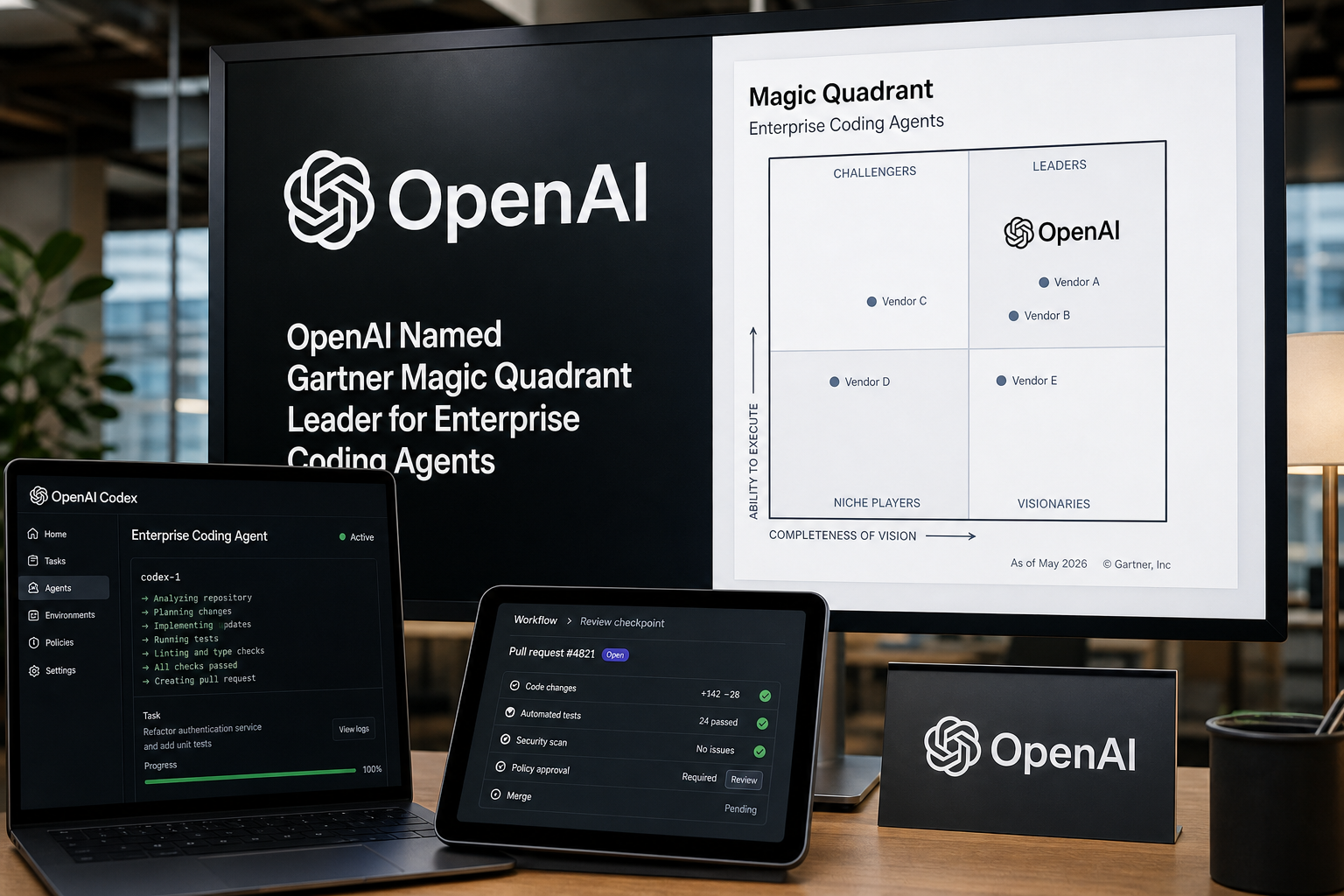
The Gartner Magic Quadrant for Enterprise AI Coding Agents is an annual analyst report evaluating software vendors on two axes: Ability to Execute and Completeness of Vision. The 2026 edition was published May 20, 2026 and assessed 12 vendors — the first edition under the "Enterprise AI Coding Agents" name, replacing the earlier "AI Code Assistants" Magic Quadrant category. The report was authored by Gartner analysts Philip Walsh, Nitish Tyagi, Keith Holloway, Matt Brasier, and Neha Agarwal. Full methodology, scoring weights, and individual vendor caution notes require a Gartner subscription; vendor-published summaries from GitHub, Cursor, and Tabnine contain the major findings publicly.
How is 'Enterprise AI Coding Agents' different from the old 'AI Code Assistants' category?
The old "AI Code Assistants" category measured passive, IDE-based assistance: autocomplete acceptance rate, inline suggestion quality, and IDE latency. The new "Enterprise AI Coding Agents" category measures autonomous, asynchronous task execution — whether agents can complete defined software tasks (drafting and submitting PRs, running test suites, interpreting failures, making multi-file edits) without continuous human input, operating inside enterprise governance structures. Key new scoring dimensions include CI/CD integration depth, multi-file context handling, RBAC and audit trail quality, sandboxed execution environments, and human-in-the-loop approval checkpoint granularity. Vendors that were optimized purely for suggestion speed but haven't built agentic infrastructure score substantially lower under the 2026 criteria than they would have under the prior category.
Why did OpenAI place in the Leaders quadrant?
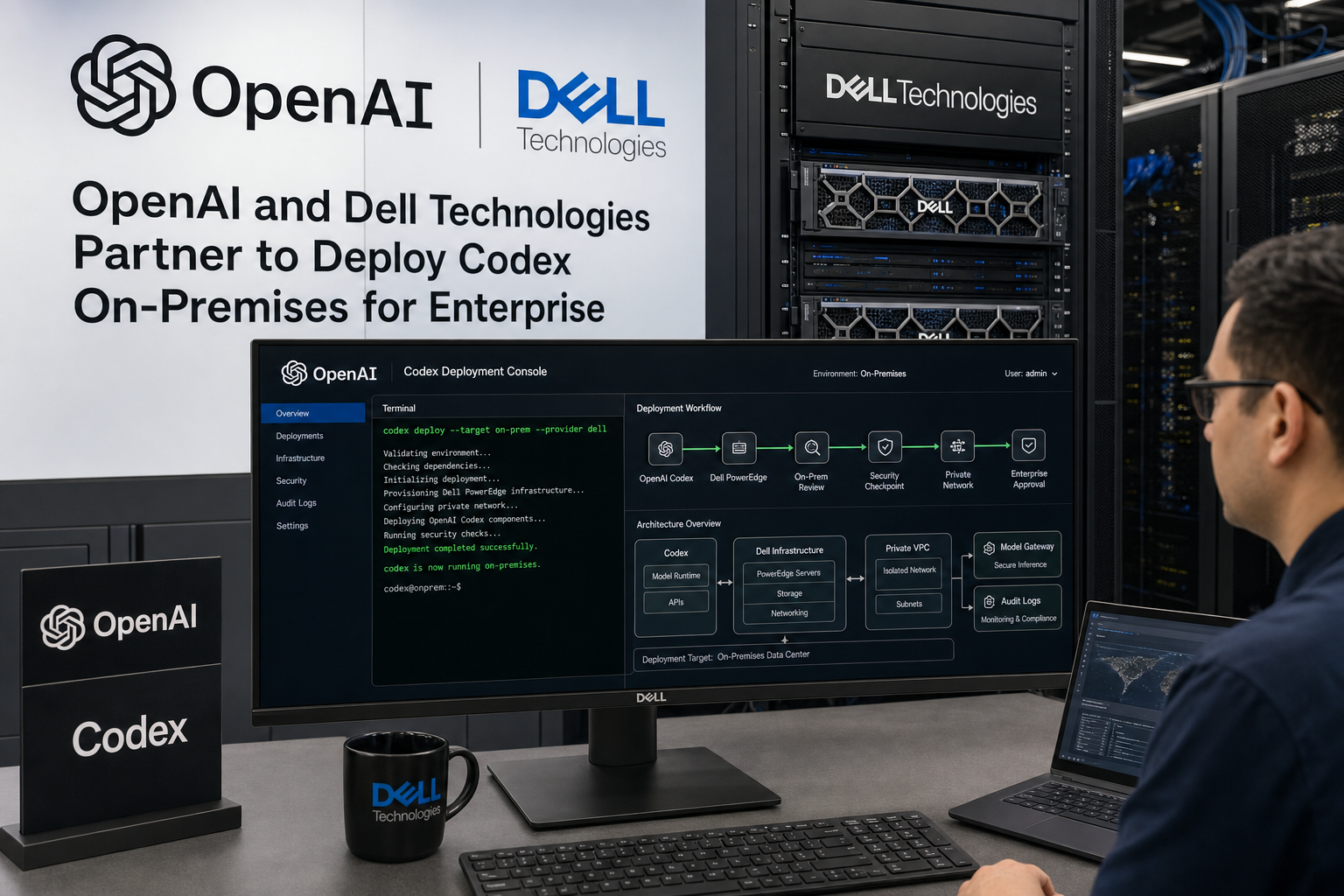
Gartner cited OpenAI Codex's enterprise governance features — sandboxing, RBAC, approval gates, and audit trail infrastructure — alongside flexible deployment options (IDE extensions, SDKs, Remote SSH for managed environments) and HIPAA-compliant configurations available via Amazon Bedrock. Codex also demonstrated strong enterprise adoption at evaluation time: over 4 million weekly users , confirmed production deployments at Cisco, Datadog, Dell, and NVIDIA, and a published case study showing Cisco using Codex to build its AI Defense security platform with significantly compressed development timelines. The combination of governance infrastructure and validated enterprise scale placed OpenAI in the Leaders quadrant.
Which vendor ranks highest on Completeness of Vision?
Cursor placed furthest on the Completeness of Vision axis among all 12 vendors in the 2026 evaluation . Gartner's Vision score rewards in-house model training investment — Cursor trains Composer 2.5 rather than routing exclusively through third-party APIs — alongside novel automation capabilities (PR automation via Bugbot, scheduled agent workflows via the Cursor SDK), open ecosystem development, and forward-looking partnerships. Cursor's reported partnership with SpaceX to develop a proprietary foundational coding model from scratch was part of the assessed vision picture. By comparison, GitHub Copilot holds the highest Ability to Execute score — a different axis, reflecting production deployment breadth and governance maturity rather than roadmap ambition.
Should developers use Gartner MQ rankings to pick their coding agent?
Gartner MQ rankings are most useful for enterprise procurement and governance conversations — they indicate which vendors meet enterprise table-stakes requirements (governance, compliance, scale, support) at this point in the market. They are less useful for individual or small-team tool selection, where workflow fit, IDE integration quality, and actual task completion performance on your specific codebase matter more than analyst scoring. For team-level tool selection, run async task-completion evaluations on real PRs in your actual repository and assess CI/CD integration depth directly. A Niche Player or Challenger that integrates cleanly with your existing toolchain may outperform a Leader on your specific workload — the MQ does not weight for that.
What to Watch Through 2026
The 2026 MQ is a snapshot of a market mid-transition. The category rename from "AI Code Assistants" to "Enterprise AI Coding Agents" codifies a product shift that has been underway in the field for 12 to 18 months. What the report does is give enterprise procurement a formal evaluation framework for that shift — agentic coding capability moves from speculative add-on to scored procurement category.
The near-term signals worth tracking: whether Anthropic publishes explicit product positioning around its Leader placement (none existed as of May 28, 2026); how the Challenger tier evolves as AWS and Google invest more specifically in open SDK ecosystems and coding-specific model training; and whether Gartner's 2028 productivity projections start appearing as verifiable enterprise case study data before the next MQ cycle. Cursor's SpaceX foundational model partnership is also worth monitoring — if it produces a coding-specific model with published benchmark results, it will directly reinforce the Vision axis justification in future evaluations.
For developers and technical leads making tooling decisions now: the procurement conversation has caught up to the product reality. Governance, auditability, and async task completion are the frame. Run your evaluation on that basis.
Last updated: 2026-05-28. Based on the Gartner Magic Quadrant for Enterprise AI Coding Agents published May 20, 2026, and vendor-published analyses from OpenAI, GitHub, Cursor, and Tabnine available as of this date. Full Gartner methodology and vendor caution notes require a Gartner subscription.