What Anthropic Bought: Colossus 1, Not Colossus 2
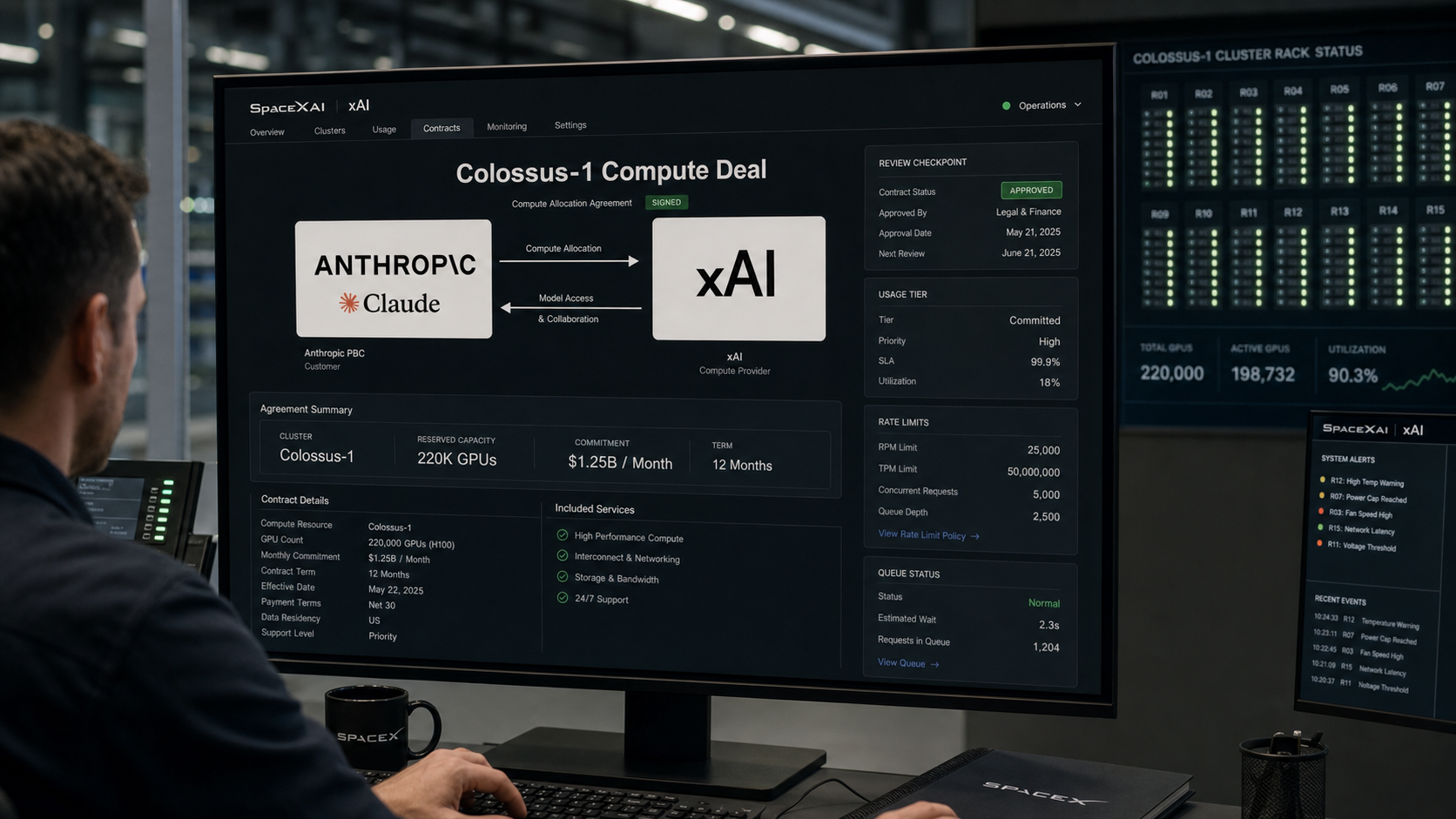
The Anthropic–xAI compute partnership, announced May 6–7, 2026, gives Anthropic exclusive access to the Colossus 1 supercomputer cluster in Memphis, Tennessee — a specific asset that most early coverage conflated with xAI's broader infrastructure footprint. xAI retains its newer Colossus 2 installation for its own Grok model training and inference; Anthropic leased the entirety of Colossus 1 — roughly 150,000 NVIDIA H100s, 50,000 H200s, and 30,000 GB200 Blackwell accelerators, totaling over 220,000 GPUs backed by more than 300 MW of power capacity. The Colossus 1/Colossus 2 distinction is absent from most coverage but matters for accurately sizing what Anthropic actually controls and what remains inside xAI's operational stack.
xAI's Colossus 2 build has not had its full specifications publicly disclosed, and xAI has given no indication of plans to lease it to third parties. What Anthropic controls is a single-facility cluster with three GPU generations co-located in the same Memphis data center footprint. The GPU mix matters for workload allocation: H100s and H200s carry the bulk of established Claude inference workloads, while the 30,000 GB200 Blackwell units represent the leading-edge compute tier optimized for higher throughput per watt and larger model context windows.
Colossus 1 was originally built and deployed by xAI in Memphis in under 122 days — a construction-to-operation timeline that drew industry attention in 2024 and became a benchmark for how quickly large-scale GPU infrastructure could be stood up outside of traditional hyperscale timelines. That same speed-first approach shapes the environmental compliance history discussed in the Memphis section below — the same urgency that produced a 122-day build produced a permitting posture that prioritized speed over regulatory process.
| Accelerator Model | Approx. Unit Count | Architecture | Memory Configuration |
|---|---|---|---|
| NVIDIA H100 SXM5 | ~150,000 | Hopper | HBM2e / HBM3 (80 GB) |
| NVIDIA H200 SXM5 | ~50,000 | Hopper (HBM3e variant) | HBM3e (141 GB) |
| NVIDIA GB200 | ~30,000 | Blackwell | HBM3e (next-gen, higher BW) |
| Total | >220,000 | — | — |
Sources: Tom's Hardware, Latent Space
Deal Terms: $1.25B/Month, a Discounted Ramp, and a 90-Day Exit

The financial terms of the Anthropic–xAI agreement are unusually concrete for a compute lease between AI companies. According to TechCrunch reporting on May 20, 2026, Anthropic pays xAI $1.25 billion per month for exclusive use of Colossus 1, with a discounted rate during the first two months while xAI completes infrastructure ramp-up. The discounted ramp reflects that Colossus 1 was not fully optimized for Anthropic's inference workloads at the moment of signing; the rack configurations, networking, and software stack needed weeks of tuning before full-rate billing was appropriate. The contract runs through May 2029.
At full rate, the annualized value of the agreement is approximately $5 billion per year, with cumulative contract exposure above $40 billion over the full term — among the largest disclosed compute agreements in AI history.
"[The] Anthropic/xAI compute deal is ~$5B/year annualized, and up to ~$40B+ over the full term through May 2029 with discounted rates in months 1–2." — Latent Space AI News, May 2026
The 90-day exit clause is the most operationally significant term for anyone treating Claude as a production dependency. Either side may terminate with 90 days' notice — meaning Anthropic could find itself scrambling for alternative capacity with roughly one fiscal quarter of runway, and xAI could reclaim more than $1.25B/month in revenue on similarly short notice. This is not a typical cloud-provider SLA with months-long ramp-down and migration windows built in. It is a bilateral escape hatch that keeps both parties in ongoing negotiation posture throughout the contract's life, and which gives neither party the operational certainty that a multi-year hyperscale agreement normally provides.
Claude inference was deployed on Colossus 1 hardware within days of the May 6–7 announcement, indicating that Anthropic pre-staged the deployment and was ready to route production traffic almost immediately after disclosure. The speed of production rollout signals that this was not a forward-looking capacity option — it was a relief valve already under pressure from active demand.
Why Anthropic Needed Third-Party Compute
Anthropic's compute shortfall in early 2026 was a direct consequence of demand growth that outpaced any realistic internal provisioning timeline. The company's ARR grew approximately 80× year-over-year — roughly 8,000% annualized run-rate expansion — a pace at which even well-capitalized GPU procurement pipelines lag by 12–18 months. No single long-term infrastructure deal, regardless of its headline size, resolves a demand spike that develops in weeks rather than quarters.
The proximate driver was Claude Code. Its rapid adoption among developers — particularly for agentic, long-context coding tasks that sustain heavy continuous inference loads — created a GPU shortfall not addressable through Anthropic's existing contracted capacity. Agentic use cases differ from standard conversational chat in a way that matters for capacity planning: a single user session can sustain inference for hours, with multiple model calls per minute, compressing what would be a day's worth of average-user demand into a single afternoon of active development work. When many such sessions run concurrently, the GPU headroom required scales non-linearly compared to the interactive usage models that Anthropic's prior capacity planning had optimized for.
Anthropic does have substantial long-term compute agreements in place. An up-to-5 GW partnership with Amazon is underway, with close to 1 GW expected to be live by end-2026. A separate 5 GW deal with Google and Broadcom is scheduled to come online starting in 2027. A $30 billion Azure capacity partnership with Microsoft and NVIDIA, and a $50 billion buildout with Fluidstack, address the even longer horizon. Together, these represent multi-gigawatt commitments across four infrastructure partners — but their common characteristic is that none resolves a capacity gap that opened in Q1–Q2 2026.
The Amazon agreement is the most advanced of the long-term deals: under 1 GW live by end-2026 means it addresses the latter part of this calendar year and scales through 2027. The Google/Broadcom deal doesn't contribute meaningfully until 2027. Azure and Fluidstack are further out as operational capacity rather than contracts. In the gap between now and when those agreements reach production scale — roughly the next 12–18 months — Colossus 1 is the only immediately available large-scale GPU pool that Anthropic could activate without building new infrastructure.
This is a structural reality in AI infrastructure, not a planning failure: frontier GPU clusters take 12–24 months from contract signing to production readiness, while LLM adoption curves can steepen in weeks. The Colossus 1 lease is the bridge that covers the window until Amazon and Google capacity comes online at sufficient scale to absorb Anthropic's demand growth independently.
Developer-Facing Changes: Rate Limits and API Quotas
The most concrete near-term signal of the Colossus 1 deal for developers was the immediate change to usage limits announced simultaneously with the partnership. Claude Code's five-hour usage limits doubled across Pro, Max, Team, and Enterprise tiers at announcement. Peak-hours throttling was eliminated for Pro and Max accounts. API rate limits for Claude Opus models were substantially raised concurrent with the deal going live. These changes took effect within days of the May 6–7 announcement as Colossus 1 capacity came online for Claude inference traffic.
For developers actively building with Claude Code, the doubled five-hour cap reduces friction for long agentic sessions that routinely approach the old limit. Tasks like large-scale refactoring, extended test generation, or multi-file context analysis can now run continuously for longer without requiring a checkpoint-and-restart cycle. Removing peak-hours throttling eliminates the time-of-day variable from latency and availability planning — a meaningful simplification for teams running automated pipelines rather than interactive sessions, since pipelines don't have natural off-peak windows built into their schedules.
The Opus rate limit increases are specifically relevant for API integrations where Opus is the preferred capability tier. Teams that had been implementing aggressive caching or request queuing to stay within prior limits now have more headroom before rate-limiting kicks in. Note that Anthropic has not published the specific new numeric values — review your dashboard and the current API documentation for your tier's actual quotas rather than relying on third-party estimates, which may lag the live values.
Some Colossus 1 capacity is specifically earmarked for enterprise customers in Asia and Europe with data residency requirements. If you're building for regulated industries or geographies with data sovereignty requirements, verify directly with Anthropic's enterprise team whether the Memphis physical infrastructure and associated data processing agreements satisfy your jurisdiction's specific criteria. Physical proximity to a US facility and contractual compliance with data residency requirements are distinct considerations that need separate confirmation.
The Reclaim Clause: Musk's Conditions and xAI's Parallel Moves

The Anthropic–xAI agreement contains a publicly stated condition that distinguishes it from any standard compute lease: Elon Musk has reserved the right to reclaim the compute if Anthropic's AI "engages in actions that harm humanity." No specific harm threshold, adjudication process, notice window, or SLA-equivalent for this clause has been publicly disclosed. It is a unilateral condition with no defined trigger criteria — which makes it contractually unusual regardless of how likely it is to be exercised.
"No one set off my evil detector," Musk said of Anthropic leadership, while also stating he "reserves the right to reclaim the compute if their AI engages in actions that harm humanity." — Elon Musk, as reported by Tom's Hardware
Musk framed the deal as alignment-informed, stating that he discussed Claude's mission with Anthropic leadership directly before signing and positioning his evaluation as a values check rather than purely a commercial one. Whether this framing reflects actual contractual provisions — or whether the reclaim clause exists in the signed contract in the form described publicly versus only in public statements — is unknown. Neither party has published the agreement. The commercial terms were confirmed by TechCrunch reporting, but the governance clauses have not been independently verified from the contract text.
For developers and enterprise teams treating Claude as a production dependency, the reclaim clause introduces governance ambiguity that standard SLA frameworks don't address. A typical cloud-provider SLA specifies uptime guarantees, incident response timelines, and compensation mechanisms for downtime. What the Colossus 1 arrangement adds — at least in public statements — is a unilateral trigger condition defined by a subjective harm assessment with no disclosed appeal process, notice window, or materiality threshold beyond the standard 90-day bilateral exit. Enterprise legal teams evaluating Claude's supply chain will need to assess a category of risk not present in hyperscale agreements: alignment-of-values risk as an operational dependency.
The timing of xAI's parallel capacity moves is worth tracking. On May 6, 2026 — the same day as the Anthropic announcement — xAI issued deprecation notices for several Grok 4.1 Fast models, giving users only two weeks before a May 15 shutdown. Whether this represents operational linkage to the Colossus 1 capacity transfer — freeing serving capacity by retiring older models — or independent product roadmap decisions has not been confirmed. The coincidence of timing is notable regardless of causal direction, and it suggests that xAI's own capacity posture shifted materially around the announcement date.
The structural concern for Anthropic is that the reclaim clause, even if never exercised, inserts a non-standard governance variable into a critical production dependency. Standard SLA risk is quantifiable: uptime SLAs, compensation schedules, incident response timelines. The reclaim clause introduces a risk that is definitionally non-quantifiable — it is triggered by Musk's evaluation of whether Anthropic's AI has crossed an undefined harm threshold, with no disclosed adjudication mechanism. That is a risk category outside the scope of conventional vendor risk management frameworks.
Environmental Liabilities at the Memphis Facility
Colossus 1 has a documented environmental compliance history that represents a non-negligible risk vector for Anthropic's dependence on it. Gas turbines used to power the Memphis facility were initially operated without Clean Air Act permits or required pollution-control devices, classified as "temporary generators" to avoid standard regulatory review — a designation contested by environmental analysts and community advocates. The "temporary generator" classification is a known regulatory arbitrage: it allows high-emission equipment to operate outside the standard New Source Review process, which would otherwise require pollution-control installations and multi-month permitting timelines.
Independent analysis linked the facility's operations to measurable degradation in local air quality and increased hospital admissions in surrounding Memphis neighborhoods. As of May 2026, no formal EPA enforcement action has been publicly announced. But the underlying compliance posture — speed-first construction, retroactive permitting, and classification choices that sidestep standard review — is the type of regulatory exposure that draws scrutiny when attached to a high-profile, high-revenue commercial agreement receiving significant media coverage.
For developers evaluating Claude as a production dependency, and for enterprise buyers subject to ESG disclosure requirements or corporate environmental commitments, this is a reputational and regulatory risk vector rather than an immediate technical one. The risks compound in three scenarios: EPA enforcement results in operational disruption at the facility; sustained public scrutiny of Anthropic's infrastructure choices creates brand exposure for customers; or corporate buyers' own environmental commitments create friction around using a service tied to a non-permitted gas turbine operation.
Anthropic's position here is structurally constrained — it didn't build Colossus 1 and wasn't responsible for its initial permitting posture. But by becoming the primary paying customer and entering a public $1.25B/month agreement, Anthropic has accepted reputational adjacency to those liabilities for the duration of the contract. Enterprise procurement teams should document this when completing vendor risk assessments, particularly if your organization is subject to Scope 3 emissions reporting or has public environmental commitments that extend to supply chain infrastructure.
Orbital Compute: What Was Said and What Is Still Missing
The Anthropic–xAI announcement included a forward-looking statement: Anthropic expressed interest in partnering with SpaceX to develop "multiple gigawatts of orbital AI compute capacity." No timeline, technical specifications, orbital altitude regime, thermal management approach, launch vehicle requirements, or connectivity architecture was disclosed alongside this statement. Treat it as a directional signal, not a roadmap commitment, and do not weight it in any architecture decision with a horizon shorter than five to ten years.
The technical challenges of orbital compute are substantively different from ground-based colocation and have not been publicly addressed by Anthropic or SpaceX. Power generation in low Earth orbit is constrained by solar panel area and orbital position relative to Earth's shadow; a satellite cluster providing gigawatts of compute would require either enormous solar arrays or nuclear power sources, neither of which has a clear near-term deployment pathway for commercial AI inference. Thermal management is considerably more complex in vacuum — air cooling is unavailable, and liquid cooling systems become critical failure points in a maintenance-inaccessible environment. And once launched, hardware cannot be upgraded; the GPU generation that enters orbit is fixed for the asset's operational lifetime.
SpaceX's Starlink LEO constellation provides the most plausible connectivity backbone for an eventual orbital compute layer — current Starlink v2 performance supports sub-20ms latency to ground stations under favorable conditions. But Starlink is a communications network, not a power or compute network; using it as the uplink/downlink layer for orbital inference would require parallel infrastructure investment in both the orbital and ground segments that has not been scoped publicly.
For developers planning multi-year infrastructure dependencies on Anthropic APIs, the operative infrastructure remains Colossus 1 (now through mid-2026 at minimum), the Amazon agreement (scaling through late 2026 and 2027), and the Google/Broadcom deal (from 2027). The orbital compute statement is contextually relevant for understanding Anthropic's long-horizon infrastructure ambitions and its relationship with SpaceX — it is not a planning input for current or near-term development work.
Anthropic's Full Compute Stack: Where Colossus 1 Fits

The Colossus 1 lease occupies a specific and time-bounded position in Anthropic's compute strategy: it is the bridge that covers 2026's demand spike while longer-term, purpose-built capacity comes online from cloud-provider partnerships. Understanding where it sits in the full stack clarifies both its strategic value and its risk profile relative to the overall agreement portfolio.
| Partner | Announced Value / Scale | Expected Live | Role in Stack | Key Risk Factor |
|---|---|---|---|---|
| xAI (Colossus 1) | $1.25B/month; ~220K GPUs; 300+ MW | Live May 2026 | Bridge: 2026 near-term gap | 90-day exit; reclaim clause; single facility; non-standard governance |
| Amazon AWS | Up to 5 GW; ~1 GW by end-2026 | ~1 GW Dec 2026; full TBD | Primary scale layer 2026–2027+ | Ramp timeline; competition for capacity |
| Google / Broadcom | 5 GW | From 2027 | Scale layer 2027+ | Delayed until 2027; Google competes directly with Claude |
| Microsoft / NVIDIA (Azure) | $30 billion commitment | Multi-year horizon | Long-horizon redundancy | Long lead time; Azure vendor dependency |
| Fluidstack | $50 billion buildout | Multi-year horizon | Long-horizon capacity diversification | Largest announced value; execution risk at scale |
| SpaceX (orbital — stated interest) | Multiple GW (speculative) | No timeline disclosed | Forward signal only | Technical feasibility; 5–10 year horizon minimum |
Sources: Anthropic, Latent Space
The table makes the dependency concentration risk explicit. Colossus 1 is a single-facility, single-operator asset with non-standard exit conditions — not a risk profile typical of a cloud-provider SLA. No second data center, no geographic redundancy within the Colossus arrangement, and no SLA that mirrors what a hyperscale cloud provider would deliver in terms of uptime guarantees, incident response timelines, or compensation frameworks. For the next 12–18 months, until Amazon capacity scales and Google/Broadcom capacity comes online, Anthropic's highest-capacity resource is also its least conventionally de-risked one.
The breadth of the full stack — five disclosed infrastructure partners spanning cloud providers, co-location operators, and a compute lease from a direct competitor — signals that Anthropic is treating no single agreement as a durable long-term solution. That diversification is constructive for developers building on Claude in a multi-year context: it substantially reduces the risk of a single-partner failure cascading into a catastrophic capacity event. But in the near term through 2026, Colossus 1 is the operative constraint. Understanding its terms, governance conditions, and timelines is the prerequisite for accurate dependency modeling if Claude is in your critical path.
Frequently Asked Questions
Does Anthropic have access to xAI's Colossus 2 cluster?
No. xAI retains Colossus 2 for its own Grok model training and inference. The Anthropic lease covers Colossus 1 exclusively — approximately 150,000 NVIDIA H100s, 50,000 H200s, and 30,000 GB200 Blackwell accelerators totaling over 220,000 GPUs and more than 300 MW of power capacity. Colossus 2's specifications have not been fully disclosed publicly, and xAI has not indicated any intent to lease its capacity to third parties. This distinction is absent from most early coverage but matters for accurately sizing what Anthropic controls versus what remains inside xAI's operational stack for Grok development.
What caused the Claude Code rate limit increase in May 2026?
The Colossus 1 deal provided immediate additional GPU capacity, and Anthropic deployed Claude inference on Colossus hardware within days of the May 6–7, 2026 announcement. This unlocked the five-hour usage limit doubling for Claude Code across Pro, Max, Team, and Enterprise tiers, the removal of peak-hours throttling for Pro and Max accounts, and substantially raised API rate limits for Claude Opus models. The underlying cause was an acute GPU shortfall driven by Claude Code's rapid adoption creating agentic inference demand that outpaced Anthropic's previously provisioned capacity.
Can Elon Musk reclaim the compute before the contract ends?
Under Musk's publicly stated terms, yes. He has reserved the right to reclaim the Colossus 1 compute if Anthropic's AI "engages in actions that harm humanity." Additionally, either party may exit the contract with 90 days' notice regardless of cause. No formal adjudication process, harm threshold definition, or notice window specific to the reclaim condition has been publicly disclosed. Whether this condition exists in the signed contract in the form described publicly, or whether it appears in more constrained language in the actual agreement, is unknown — neither party has published the contract text.
What are the environmental concerns about the Memphis facility?
Gas turbines at the Colossus 1 Memphis facility were initially operated without Clean Air Act permits or required pollution-control devices. The facility classified these turbines as "temporary generators" to avoid standard regulatory review — a categorization contested by environmental analysts. Independent analysis has linked facility operations to local air quality degradation and increased hospital admissions in surrounding Memphis neighborhoods. As of May 2026, no formal EPA enforcement action has been publicly announced. For Anthropic as a paying customer, these are unresolved regulatory and reputational liabilities. Enterprise buyers subject to ESG reporting or Scope 3 emissions requirements should document this in vendor risk assessments.
How does the Colossus deal relate to Anthropic's agreements with Amazon, Google, and Microsoft?
The Colossus 1 deal addresses a near-term gap that the other agreements cannot fill on the same timeline. Amazon's capacity (~1 GW) begins coming online in late 2026; Google/Broadcom's 5 GW deal arrives in 2027; the $30B Azure and $50B Fluidstack commitments are further out as operational capacity. Colossus 1 is operational now — it is the bridge that covers the 2026 window of acute demand driven by Claude Code adoption. The cloud-provider stack represents longer-term, geographically distributed, purpose-built infrastructure with conventional SLA frameworks. Colossus 1 is one instrument in a diversification strategy, not a replacement for it.
What to Watch From Here
The Anthropic–xAI compute deal is most accurately read as a signal about where the LLM infrastructure market stands, not where it is going. The fact that a company at Anthropic's scale — with billions committed across Amazon, Google, Microsoft, and Fluidstack — still needed to lease compute from a direct competitor to cover a near-term demand spike illustrates how far actual GPU availability lags the announcement cycle of large AI infrastructure agreements. Signed contracts and operational capacity are different categories, and the gap between them is currently measured in quarters to years at the frontier scale.
For developers and technical teams, the practical near-term upshot is clear: Claude API availability and rate limits are structurally better than they were in Q1 2026 — the capacity is live and the limit increases are in effect. The 90-day exit clause and the reclaim condition are real risk factors worth tracking and documenting in vendor assessments for any production system with hard uptime requirements, particularly where no fallback model is pre-integrated. The Amazon and Google/Broadcom capacity coming online through 2026–2027 will progressively reduce Anthropic's dependence on the Colossus arrangement; watch for announcements of additional limit increases or new geographic availability as that capacity becomes operational.
The orbital compute statement belongs in peripheral vision rather than planning assumptions for any horizon under five years. The Memphis environmental compliance history is worth monitoring for enforcement developments that could affect facility operations. And the competitive dynamic — Anthropic paying a competitor over $1.25B/month while building independent capacity with Amazon, Google, and Microsoft — remains a structural tension that neither party has an obvious incentive to resolve publicly before the contract reaches its May 2029 term or either side exercises the 90-day exit.
Last updated: 2026-05-29. Based on reporting and analysis available through May 29, 2026. Contract terms not independently published by either party; financial figures sourced from TechCrunch and Latent Space reporting. Verify current API rate limits against your Anthropic dashboard before making capacity planning decisions.