Subscription vs. Direct Usage: Which Fits Your Workflow

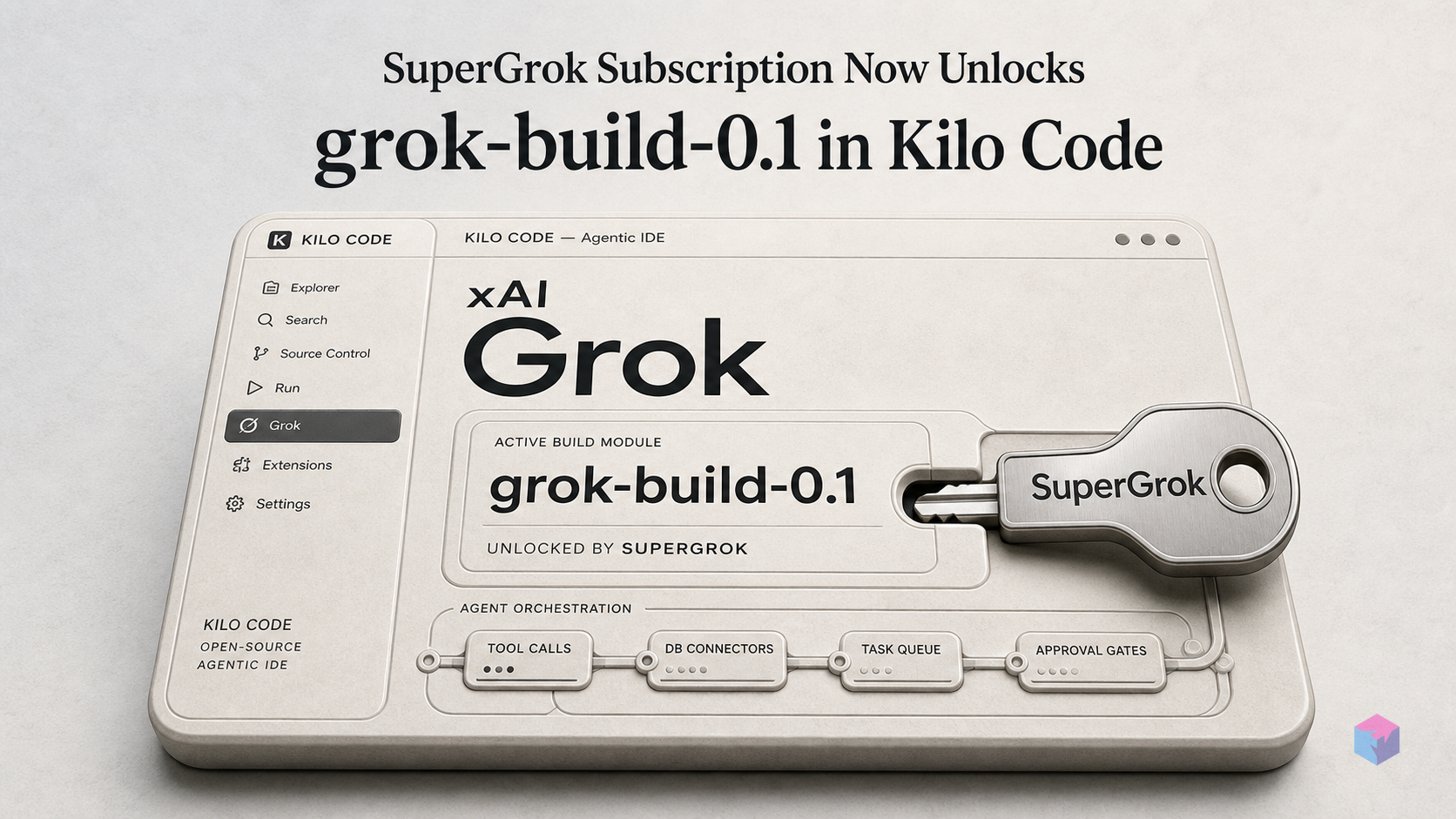
The decision between subscription access and direct API usage depends primarily on usage volume and tolerance for credential management overhead. SuperGrok and X Premium+ subscriptions include grok-build-0.1 at no incremental per-task cost within subscription limits. Pay-as-you-go via the xAI Console or OpenRouter charges $1.00 per million input tokens, $2.00 per million output tokens, and $0.20 per million cache read tokens.
At those rates, lightweight tasks are cheap: analyzing a 10,000-line codebase — approximately 40,000 input tokens for the code plus 10,000 output tokens for a summary — costs roughly $0.06 per run. But grok-build-0.1 is optimized for extended agentic sessions. PinchBench's extended task average comes in at $20.58 per run via direct API. A team running ten deep agentic sessions per day on pay-as-you-go would spend over $200/day in model costs before accounting for infrastructure.
Subscription access eliminates incremental per-task charges but introduces a constraint xAI has not publicly documented as of May 2026: session-level and daily rate limits under the subscription tier. If you plan to run grok-build-0.1 continuously or in high-volume batch workflows, test the limits on representative workloads before committing to infrastructure that assumes unthrottled throughput.
The credential management difference is also a real operational consideration. The OAuth path has no API key to rotate, no risk of a key appearing in source control, and no secrets manager dependency. The pay-as-you-go path requires an API key in your environment — managed as a CI secret, stored in a secrets manager, or sourced from an environment variable. For solo developers or small teams without an established secrets management workflow, the subscription OAuth path removes one category of operational risk.
A third option in the xAI/Kilo ecosystem: Grok Code Fast 1 Optimized is available through Kilo Cloud, currently free during a promotional period with post-promo pricing at $0.20 per million input tokens. It uses test-time compute scaling to adjust compute dynamically per request — faster and cheaper than grok-build-0.1 for tasks that do not require deep agentic reasoning. It is a separate model and does not share the 256,000-token context window or the uncapped output design. For quick refactors, single-file edits, or lightweight generation tasks, it is a cost-effective alternative while the promo pricing holds.
Kilo Code Feature Tiers: What SuperGrok Does and Does Not Cover

The SuperGrok subscriber OAuth path is scoped to Kilo Code's core developer tools: the VS Code extension, JetBrains plugin, and terminal CLI. It does not extend to Cloud Agents or KiloClaw. Establishing this boundary clearly prevents wasted time building workflows that assume subscriber OAuth covers Kilo's full platform feature set.
Cloud Agents are Kilo's cloud-hosted execution environment: they run multi-agent tasks on Kilo's infrastructure without requiring a local machine or self-hosted runner. KiloClaw is Kilo's orchestration layer for coordinating parallel agent workflows. Both require a Kilo Gateway API key — a separate purchase outside any xAI subscription. Teams whose workflows need cloud-hosted execution or parallel agent coordination should evaluate Kilo Gateway pricing independently before designing for those features.
For teams weighing lock-in risk: Kilo Code's model-agnostic design means switching from grok-build-0.1 to any other supported model is a provider configuration change, not a workflow rewrite. Agent task definitions, MCP tool configurations, and prompt templates persist across the switch. If grok-build-0.1 underperforms on your specific task distribution, the cost to move is low — the right property for adopting a recently released model with limited production history.
On production readiness: the Grok Build CLI has no announced general availability date as of May 2026. The Kilo Code IDE extension integrating grok-build-0.1 via subscriber OAuth is production-available. The standalone CLI is explicitly beta. Treat these as separate products with different readiness levels when making infrastructure decisions — the IDE integration is deployable today; the CLI warrants a sandboxed evaluation period first.
Frequently Asked Questions

Do I need to copy an API key to use grok-build-0.1 in Kilo Code with a SuperGrok subscription?
No. Kilo Code uses a PKCE OAuth flow to authenticate SuperGrok and X Premium+ subscribers via xAI's authorization server. The flow completes in a browser redirecting to localhost:56121; nothing is pasted into a config file or environment variable. Credentials rotate automatically on each use. For headless environments such as Docker containers or CI runners, a device-code variant of the same flow handles authentication without a local browser. At no point is a credential manually managed or stored in plaintext.
Does the SuperGrok integration work in JetBrains IDEs as well as VS Code?
Yes. Both the VS Code extension and the JetBrains plugin use the same xAI provider configuration and the same OAuth entry point in Kilo Code's settings panel. There is no separate setup procedure for each IDE. The terminal CLI also uses the same authentication flow. A developer working across VS Code on one machine and a JetBrains IDE on another completes the OAuth flow once per environment and uses the same provider configuration in both.
What is the practical difference between a SuperGrok subscription and paying per call through xAI Console?
Subscribers use grok-build-0.1 at no incremental per-task cost within subscription limits, with no API key to manage. Pay-as-you-go via the xAI Console or OpenRouter charges $1.00 per million input tokens and $2.00 per million output tokens. For occasional or burst usage — a few extended sessions per month — pay-as-you-go may total less than maintaining a subscription. For daily high-frequency agentic workflows, where each extended session averages $20.58 in direct API costs, subscription access becomes the more cost-effective path once usage crosses the break-even threshold.
Can I run the Grok Build CLI without a SuperGrok subscription?
No. As of May 2026, the Grok Build CLI is restricted to SuperGrok and X Premium+ subscribers, with no announced API-key-only access path. The CLI is also in early beta and is not recommended for production-critical pipelines. Developers who need a terminal-based coding agent without an xAI subscription can use Kilo Code's open-source CLI, which routes to grok-build-0.1 via direct API key on pay-as-you-go terms — providing access to the same underlying model through a different auth path.
What are Cloud Agents and KiloClaw, and why does the subscriber path not include them?
Cloud Agents are Kilo's cloud-hosted execution environment for running multi-agent tasks on Kilo's infrastructure without a local machine or self-hosted runner. KiloClaw is Kilo's orchestration layer for coordinating parallel agent workflows at scale. Both are features of Kilo's paid cloud platform tier and require a separate Kilo Gateway API key. The SuperGrok subscriber OAuth path grants access to the core developer tools — VS Code extension, JetBrains plugin, and terminal CLI — but does not cover cloud-hosted compute or orchestration services, which carry their own infrastructure costs independent of model access pricing.
What to Evaluate Before Committing to This Integration
The xAI–Kilo Code integration is a practical option for developers who already hold a SuperGrok or X Premium+ subscription and want a capable agentic coding model without API key overhead. grok-build-0.1's 4th-place ranking on PinchBench across 50 evaluated models — with category leaders in Log Analysis at 97.0% and CSV Analysis at 96.1% — positions it as a reliable option for structured data and extended codebase tasks, precisely where its 256,000-token context window provides a structural advantage.
The areas worth monitoring before building production dependencies: subscription-tier rate limits for extended agentic sessions are not publicly documented, the Grok Build CLI carries a beta label with no GA date announced, and the model's 95th-place community usage rank on Kilo's leaderboard reflects limited real-world adoption data so far. None of these are blocking concerns for evaluation — they are the normal conditions of a recently released model integrated into a mature toolchain.
The right next step for most teams: run grok-build-0.1 against five to ten representative tasks from your actual codebase, compare results against your current model configuration, and verify whether subscription rate limits constrain your intended usage volume. Kilo Code's model-agnostic design keeps the switching cost low in either direction — adopt the model where it outperforms, keep your existing configuration where it does not.
Last updated: 2026-05-29. Article based on xAI and Kilo Code announcement materials published in May 2026.