
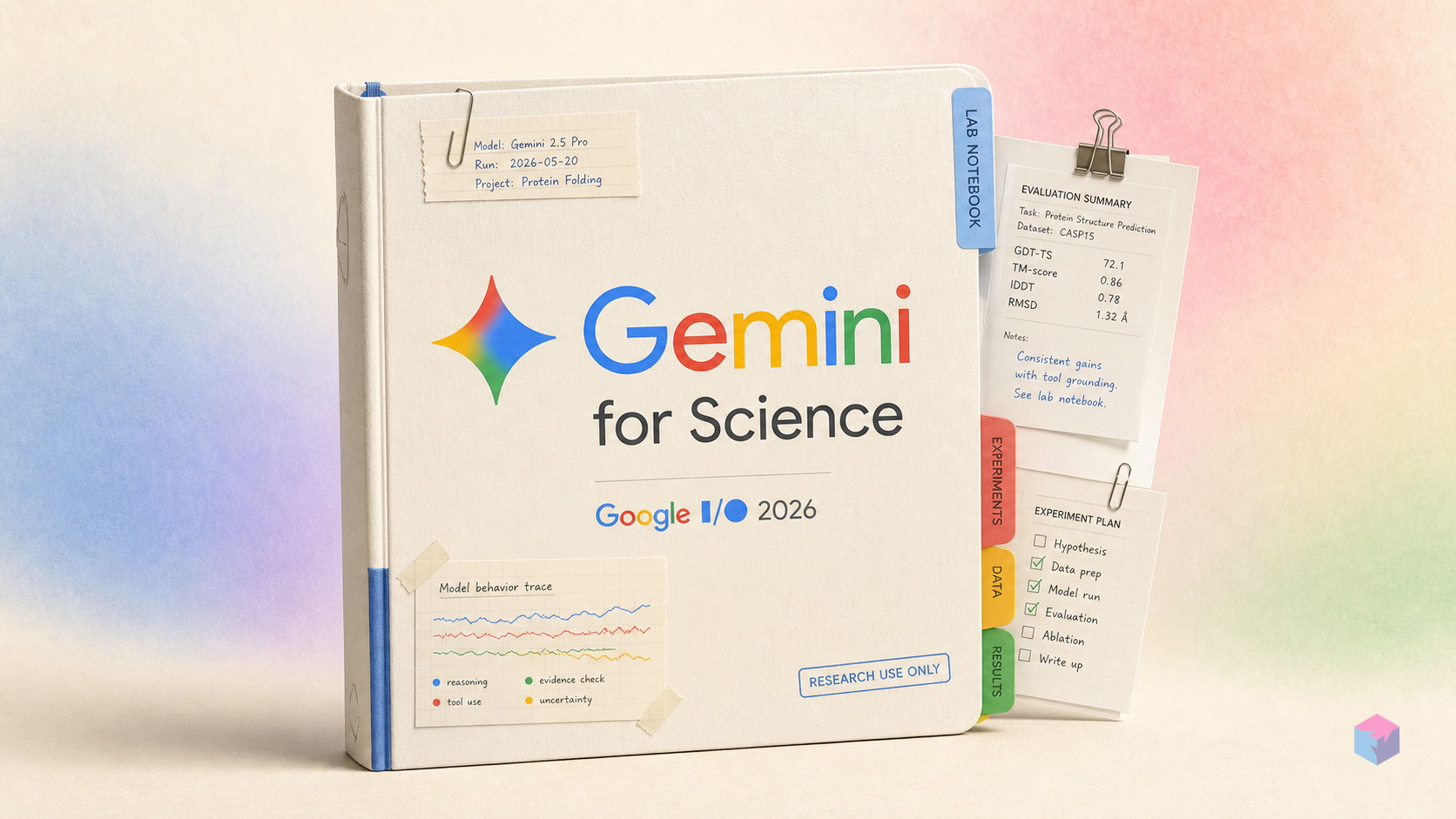
science-io-2026/" data-source-date="2026-05">[1]. When a researcher submits a query, Antigravity determines which subset of integrated databases to call, executes those queries, and returns a synthesized response. The practical effect: a researcher who previously wrote separate integration scripts for AlphaFold, UniProt, and ChEMBL can express a multi-database query as a single prompt without configuring individual connections. The complete list of 30+ databases has not been published.
Four databases are confirmed in the public announcement: AlphaFold Database (predicted protein 3D structures), AlphaGenome API (genomic sequence-level predictions), UniProt (protein sequences and functional annotations), and InterPro (protein domain classification and functional family annotation) . ChEMBL is used by Co-Scientist for hypothesis cross-verification and is likely in the Science Skills bundle, but was not explicitly named as a Science Skills integration in the I/O 2026 announcements.
| Database | Domain | Data Type | Status in Science Skills |
|---|---|---|---|
| AlphaFold Database | Structural biology | Predicted 3D protein structures | Confirmed |
| AlphaGenome API | Genomics | Genomic sequence-level predictions | Confirmed |
| UniProt | Proteomics | Protein sequences, functional annotations, cross-references | Confirmed |
| InterPro | Protein analysis | Domain classification, protein family annotation | Confirmed |
| ChEMBL | Chemical biology | Bioactive molecules, drug targets, assay data | Via Co-Scientist integration; not explicitly named in Science Skills |
| 25+ additional databases | Life sciences (scope unspecified) | Not disclosed | Unconfirmed individually |
Google claims structural bioinformatics and genomic analysis workflows that previously required hours can now be completed in minutes using Science Skills . No independent benchmark has been published to verify this. The baseline is not defined — the "hours" comparison could refer to raw API query latency across individual databases, or it could include researcher time writing and debugging integration scripts. Both interpretations would yield different numbers, and the claim covers both scenarios ambiguously.
The Antigravity routing layer introduces a transparency tradeoff worth weighing explicitly. Because Antigravity selects which databases serve which parts of a query automatically, provenance tracking is the responsibility of its internal citation mapping — not the researcher's own query logic. A team building on top of Science Skills cannot inspect routing decisions or evaluate query plans. Antigravity is not publicly documented and provides no programmatic access surface outside the Gemini for Science interface. For reproducibility-sensitive workflows, this opacity is a genuine evaluation gap.
Enterprise Betas and the Institutional Research Network

Gemini for Science launched with a named enterprise beta cohort and more than 100 academic institution partnerships , including Stanford University, Imperial College London, and the Francis Crick Institute . The enterprise cohort segments by tool: BASF and Klarna test Computational Discovery; Daiichi Sankyo, Bayer Crop Science, and U.S. Department of Energy National Labs test Co-Scientist. The segmentation indicates the three tools remain distinct beta programs — enterprise participants do not appear to have cross-tool access under a unified platform contract.
Institutional research results presented at I/O 2026 span three universities. At the University of Cambridge, Co-Scientist was applied to antimicrobial resistance research . At Duke University, it supported 2D semiconductor fabrication. At Rutgers University, it was used to identify mathematical errors — a domain that suggests the hypothesis-debate pipeline can operate on formal reasoning tasks, not only experimental biology. None of these results have been independently peer-reviewed specifically to isolate the Co-Scientist contribution from the research team's existing methodology.
"The partnerships with leading research institutions allow us to validate these tools against the hardest scientific problems — that is where we learn whether the approach is genuinely useful or just interesting in controlled conditions." — Yossi Matias, VP Google Research, Google I/O 2026 (source: Google Blog, May 2026)
The ICML, STOC, and NeurIPS peer review pilot deserves specific attention from developers working in the ML research ecosystem . This initiative extends Gemini for Science into conference infrastructure — not laboratory data analysis. AI-assisted peer review at major ML conferences affects how research gets evaluated and published, which has downstream effects on what research enters the training data for future models and which benchmarks become accepted as standard. The specific capabilities being piloted — reviewer matching, reproducibility checking, conflict-of-interest detection — were not detailed in the public announcement.
For organizations evaluating enterprise access: the absence of pricing or published terms is a practical barrier. All named beta participants are large institutions with existing Google Cloud relationships, which implies the current enterprise path requires negotiation rather than self-serve enrollment. No waitlist or application process was publicly announced.
Converged vs. Previously Siloed: What Is Technically Novel

The core architectural novelty in Gemini for Science is workflow convergence. Before I/O 2026, NotebookLM, Co-Scientist, and AlphaEvolve were separate products with separate interfaces and no shared data routing layer . Gemini for Science collects them under one researcher-facing surface. Science Skills adds a curated database routing layer that replaces the per-tool configuration researchers previously managed through direct API calls to ChEMBL, UniProt, and similar services. The engineering value of the integration is real even though no new model capability was introduced.
Within the individual tools, the components most technically distinct from rebranded LLM chat are the Elo-based hypothesis ranking in Co-Scientist and the parallel mutation loop in AlphaEvolve. Elo scoring for hypothesis selection eliminates the need for a human label on which hypothesis is better — the tournament history generates the ranking signal and improves monotonically with comparison count. AlphaEvolve's parallel mutation-and-score cycle generates population diversity automatically and selects by execution output rather than by model confidence score. Both mechanisms have precedent in AI research (tournament training, evolutionary algorithms) but represent deliberate architectural choices rather than surface-level interface changes.
Practical caveats for technical evaluators:
- No pricing disclosed: No tier — consumer, academic, or enterprise — was announced for any component. Budget planning is not possible from current public information.
- No programmatic interface: None of the three tools has a published API. Teams needing to integrate Gemini for Science into automated pipelines have no current path.
- Timeline undefined: "Gradual rollout" from May 2026 has no published schedule or queue mechanics for labs.google/science. Enterprise timelines are similarly open-ended.
- No independent benchmarks: Google's performance claims for Science Skills workflows have not been independently verified. Literature Insights has not been compared to Elicit, Semantic Scholar, or Colab-native retrieval in a controlled evaluation.
- Database scope gaps: The 30+ database count applies to life science; coverage for materials science, climate science, or chemistry outside the biomedical context has not been addressed .
For developers deciding whether to engage now or wait: the strongest near-term signal is the enterprise beta segmentation. If your organization has an existing Google Cloud relationship and a well-defined life science or industrial simulation workload, direct outreach for beta access is plausible. For organizations without that relationship, tracking the labs.google/science rollout is the realistic near-term path.
Frequently Asked Questions

Is Gemini for Science a new model, or does it run on existing Google AI systems?
Gemini for Science is not a new model. It is a workflow integration layer announced at Google I/O on May 19, 2026 . Literature Insights runs on Google NotebookLM. Co-Scientist is a separately architected multi-agent system first described in a peer-reviewed Nature paper, with its own seven-module pipeline. Computational Discovery runs on AlphaEvolve (a code evolution engine) and ERA (an experiment execution and interpretation layer). Science Skills routes queries through Google Antigravity to more than 30 external life science databases. No new foundation model and no new fine-tuned checkpoint was introduced as part of this initiative.
How does Co-Scientist's Elo-based hypothesis ranking work?
Co-Scientist's Ranking module runs pairwise comparisons between candidate hypotheses and assigns Elo scores, using the same scoring methodology used in AlphaGo and AlphaStar tournament training . Each comparison is treated as a match: the winner's score increases, the loser's decreases, and the adjustment magnitude reflects the pre-match score differential. Reliability improves as comparison count increases, without requiring a human to label which hypothesis is better. Higher-scoring hypotheses advance from the Debate phase into the Evolve phase, where an Evolution agent refines and recombines them for the next scoring cycle.
Can independent researchers access Gemini for Science, or is it enterprise-only?
Independent researchers can access Gemini for Science through labs.google/science, which began a gradual rollout in May 2026 . Enterprise organizations have a separate access path through Google Cloud. No pricing, waitlist mechanics, or access eligibility criteria were publicly disclosed at launch. The named enterprise beta participants — BASF, Klarna, Daiichi Sankyo, Bayer Crop Science, and U.S. DOE National Labs — suggest the enterprise path currently requires a negotiated arrangement with Google rather than self-serve enrollment.
What databases are included in Science Skills?
Four databases are confirmed: AlphaFold Database (protein 3D structure predictions), AlphaGenome API (genomic sequence predictions), UniProt (protein sequences and functional annotations), and InterPro (protein domain classification) . Google states that Science Skills integrates more than 30 life science databases in total, but the complete list has not been published. All databases are accessed through Google Antigravity via natural-language prompts rather than direct per-database API calls. ChEMBL is used by Co-Scientist for hypothesis cross-verification but was not explicitly listed as a confirmed Science Skills integration in the I/O 2026 announcements.
What is Google Antigravity and why does it matter for Science Skills?
Google Antigravity is Google's internal agentic orchestration platform that routes queries between AI tools and external data sources. Science Skills is a specialized bundle inside Antigravity: when a researcher submits a prompt, Antigravity determines which databases to query, executes those calls, and synthesizes results into a single response — without the researcher configuring individual database connections. Antigravity is not a publicly documented or commercially available product. Researchers cannot inspect its routing logic, evaluate query plans, or integrate with it programmatically outside the Gemini for Science interface. The abstraction reduces per-database configuration overhead but removes transparency into how any given result was assembled — a significant consideration for reproducibility-sensitive workflows.
What the Convergence Means for Research Infrastructure Builders
Gemini for Science is a consolidation of Google's AI research tooling into a single researcher-facing surface. The work — combining NotebookLM's document analysis, Co-Scientist's adversarial hypothesis engine, and AlphaEvolve's evolutionary code optimization under one umbrella, with Science Skills providing database routing — addresses a real friction point: researchers currently context-switch between multiple platforms and API integrations to run workflows that Gemini for Science aims to handle in a single session. That integration has engineering value independent of whether any individual component is technically unprecedented.
The gaps identified at launch are concrete blockers for production evaluation. No programmatic interface. No pricing. No published timeline for the labs.google/science rollout beyond "gradual from May 2026." No independent benchmarks for Literature Insights against Elicit or Semantic Scholar, or for Science Skills workflow performance against direct database API integrations. The Science Skills database scope outside life science is unspecified. These are not unusual constraints for an experimental release, but they are real barriers for teams evaluating vendor commitment or pipeline integration based on the I/O 2026 announcement.
The ICML, STOC, and NeurIPS peer review pilot is the development most likely to have compounding downstream effects for the ML developer community. If AI-assisted peer review tooling becomes standard conference infrastructure, the tools that generate and structure research content gain relevance as upstream components in the research pipeline — independent of when any Gemini for Science tool reaches general availability. That is the signal worth tracking on a separate timeline from the experimental product rollout itself.
Last updated: 2026-05-29. Based on Google I/O 2026 announcements and available documentation as of launch date. Access terms, database integrations, and pricing are subject to change as the experimental rollout progresses.