What xAI Shipped to Kilo Code's Model Roster
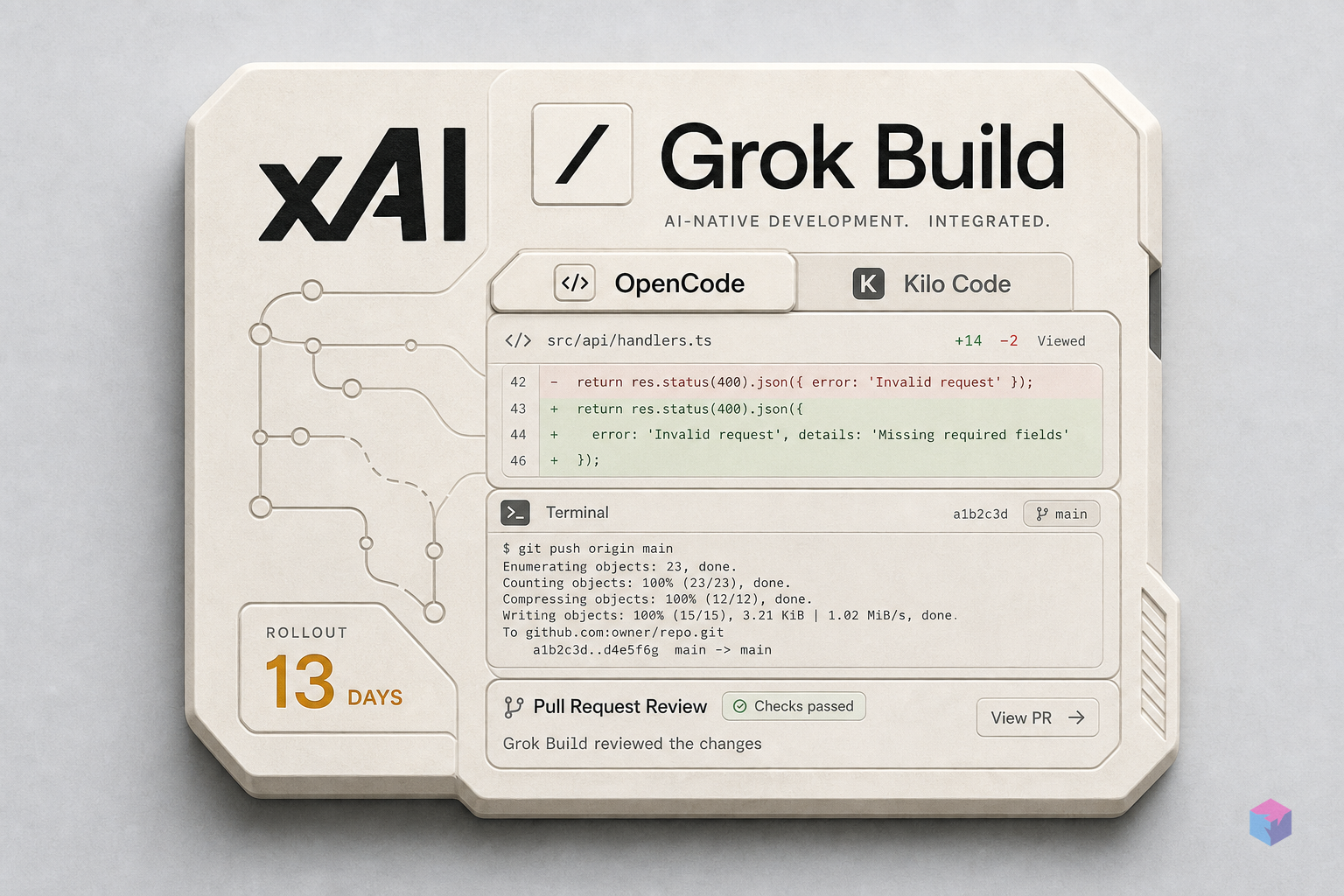
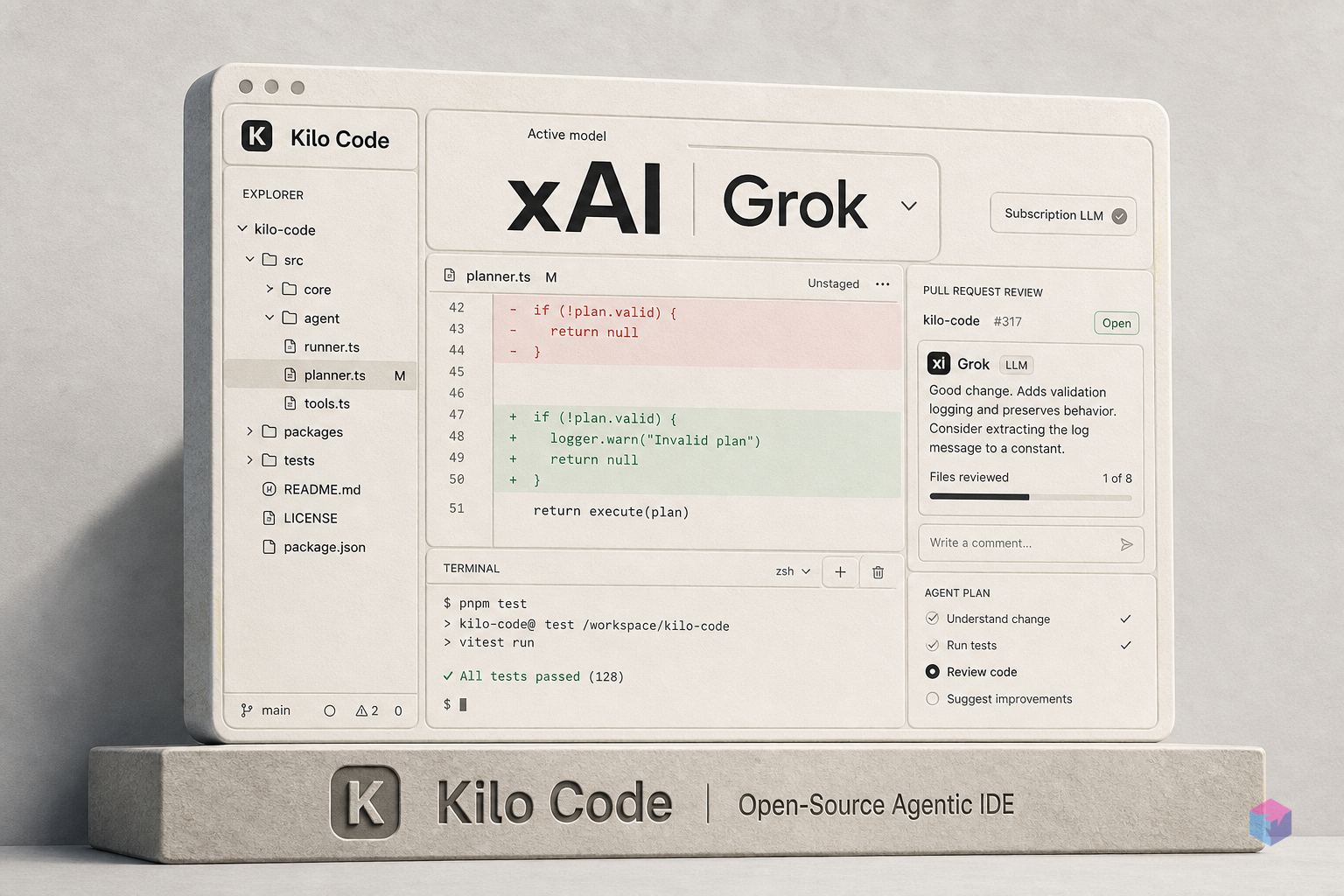
On May 27, 2026, xAI added three Grok models to Kilo Code simultaneously: grok-build-0.1 for autonomous refactoring loops, Grok 4.3 for large-context retrieval, and Grok Code Fast 1 for speed-first iteration . The rollout was coordinated across seven IDE partners — GitHub Copilot, Cursor, Cline, Roo Code, OpenCode, and Windsurf, in addition to Kilo Code . The structural change underneath the model names is more significant than the models themselves: X Premium+ and SuperGrok subscription credentials now authenticate directly into Kilo Code via a standard OAuth browser flow, eliminating the need for a separate xAI developer account or per-token billing setup .
grok-build-0.1, Grok 4.3, and Grok Code Fast 1 — to Kilo Code. Access requires only an X Premium+ or SuperGrok subscription authenticated via OAuth; no separate xAI developer account or API billing is needed. All three models are included in subscriber plans at no additional per-run cost.
All three models are included in SuperGrok (approximately $30/month) and X Premium+ (approximately $16/month) at no marginal cost per run . Previously, using Grok inside a third-party coding agent required generating an xAI API key and maintaining a separate developer billing account. The consumer subscription now acts as the credential layer — a meaningful change in how developer tooling accesses frontier models.
What distinguishes Kilo Code from most others in the seven-partner rollout is its open-source Apache 2.0 licensing, bring-your-own-key (BYOK) model, and zero token markup for subscribers who connect their own credentials . A developer on SuperGrok pays the flat subscriber fee, connects via OAuth once, and routes tasks through Kilo Code's model catalogue without any additional billing surface.
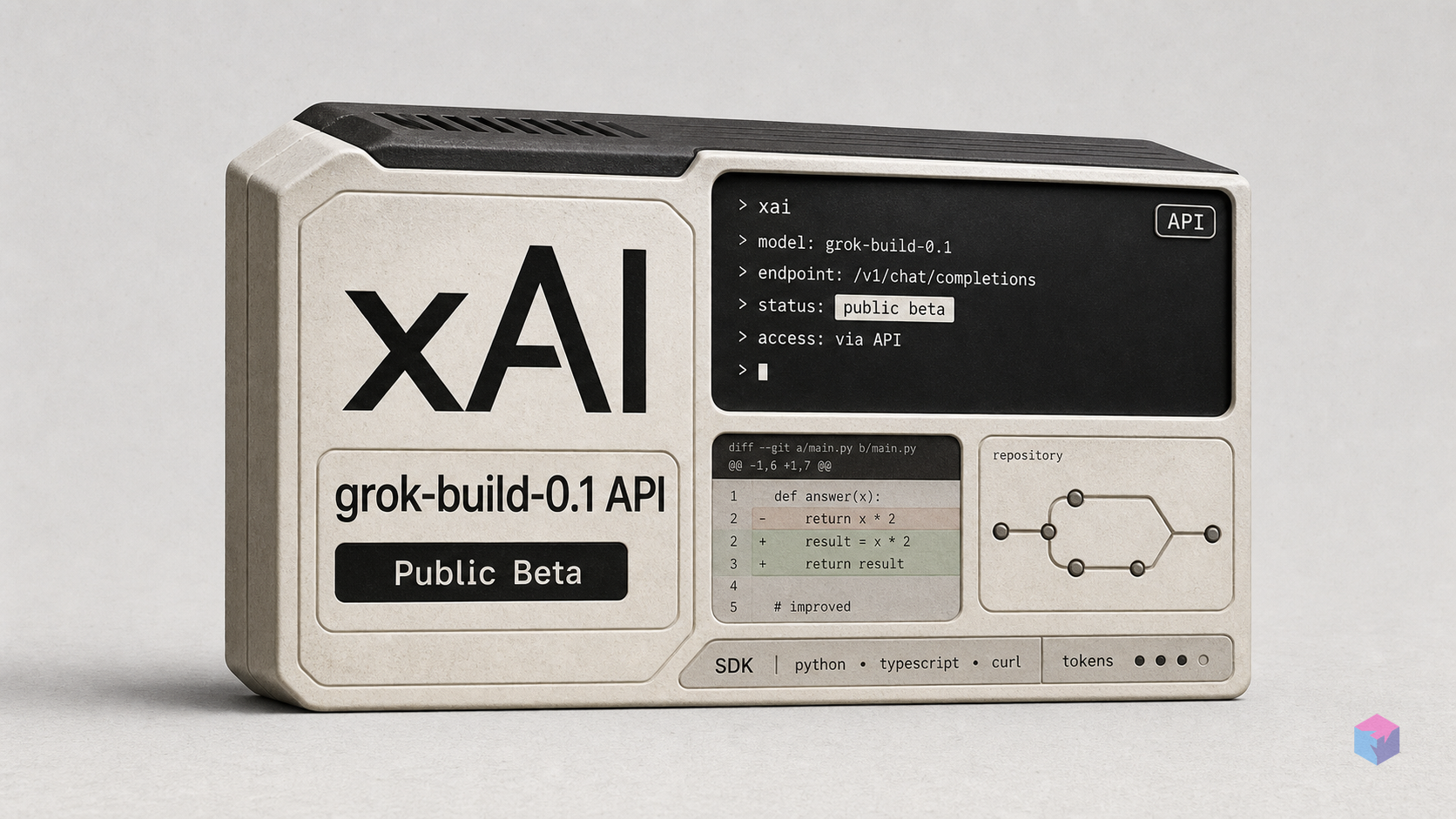
grok-build-0.1 was released by xAI on May 20, 2026 , with subscriber access rolling out to Kilo Code on May 27. It is the most technically differentiated of the three: purpose-built for agentic loops rather than conversational chat, with native tool invocation, unlimited text output, and structured JSON schema validation built into its architecture. Grok 4.3 and Grok Code Fast 1 were added simultaneously, covering different positions on the cost-speed-context trade-off spectrum.
Side-by-Side Model Specifications

The three Grok models added to Kilo Code serve distinct engineering needs, and their specifications reflect those design targets. grok-build-0.1 is optimized for agentic task completion with a 256,000-token context window, native tool invocation, and structured JSON schema validation . Grok 4.3 prioritizes large-context retrieval with a 1,000,000-token context window and the highest raw output speed of the trio at 218 tokens per second . Grok Code Fast 1 trades context depth for cost efficiency, with input pricing at $0.20 per million tokens — the lowest in the trio via direct API billing .
| Model | Context Window | Output Speed | Benchmark | API Pricing (Input / Output per M tokens) | Subscriber Cost |
|---|---|---|---|---|---|
grok-build-0.1 |
256K tokens | Not published | 88.9% PinchBench Agentic (#4 of 50) | $1.00 / $2.00 | Included — SuperGrok & X Premium+ |
| Grok 4.3 | 1,000K tokens | 218 tok/s | 41.0 Kilo Coding Index | $1.25 / $2.50 | Included — SuperGrok & X Premium+ |
| Grok Code Fast 1 | Not published | Optimized (test-time compute) | 70.8% SWE-Bench Verified | $0.20 / $1.50 | Included — SuperGrok & X Premium+ |
grok-build-0.1 stands out on the agentic benchmark dimension. Its 88.9% PinchBench Agentic score places it fourth among 50 officially benchmarked models, with an average cost per full agentic run of approximately $20.58 at API rates . That figure matters for the subscriber pricing calculus: at those API rates, a SuperGrok plan at approximately $30/month covers roughly one to two full autonomous runs before subscriber pricing becomes cheaper than direct API billing.
Grok 4.3's 1,000,000-token context window is the largest of the three by a factor of roughly four. At 218 tokens per second output and a Kilo Coding Index of 41.0 , it delivers the highest raw throughput in the trio — relevant when you need to retrieve and process an entire mono-repo without chunking logic. The trade-off is that Grok 4.3 is not architecturally designed for multi-step autonomous loops in the way grok-build-0.1 is.
Grok Code Fast 1 uses test-time compute scaling — a reasoning model architecture where inference compute scales proportionally to prompt difficulty. Its 70.8% score on SWE-Bench Verified (on xAI's internal harness) is competitive for iterative completions . At $0.20/M input tokens, it is approximately five times cheaper per input token than grok-build-0.1 at API rates, and 6.25 times cheaper than Grok 4.3. For subscribers, the cost distinction disappears — all three are included in the same plan.
X Premium+ and SuperGrok as Developer Credentials
The OAuth subscription bridge is the most structurally novel aspect of this launch. Instead of generating a developer API key through xAI's developer portal, Kilo Code users authenticate with their X Premium+ or SuperGrok consumer subscription via a standard browser-based OAuth flow — no xAI developer account, no separate billing layer, and no per-request token charge outside the subscription . The consumer plan functions as the API credential.
"Your X Premium+ or SuperGrok subscription now works directly as your authentication credential inside Kilo Code — no separate API account or billing setup required." — Kilo Code Team, Kilo Code Blog (May 2026)
For BYOK users, Kilo Code charges zero markup on tokens — model costs are absorbed into the subscriber's plan rather than billed per request through the IDE . This makes the cost model straightforward to reason about: a developer on SuperGrok at approximately $30/month knows their cost ceiling up front. A developer on X Premium+ at approximately $16/month pays less and accesses the same three-model roster.
The break-even arithmetic for grok-build-0.1 is direct. At API rates, one full autonomous agentic run costs approximately $20.58 . SuperGrok at $30/month therefore covers roughly one to two full autonomous runs before the subscriber plan costs less than direct API billing. If you run autonomous refactoring jobs more than once or twice per month — and no hard compute quota has been published by xAI as of this writing — the subscriber plan wins on cost.
From a market strategy perspective, this places xAI in direct competition with Cursor's $20/month closed bundle . Cursor couples its IDE with a bundled LLM at a fixed price; xAI's approach routes token volume through an open-source tool with no token markup. The structural bet is that developer adoption via a BYOK, open-source interface compounds faster than closed-bundle adoption, while consumer subscription revenue provides a parallel monetization floor that doesn't depend on developer API billing volume.
Headless and Server Environments

Kilo Code documents a separate headless OAuth path for environments where a browser is unavailable — VPS instances, SSH sessions, Docker containers, and WSL setups . The flow allows credential generation on a browser-capable machine, then injection of those credentials into the headless target environment. No GUI is required on the machine running inference tasks.
The OAuth credential set is compatible with CI pipelines and remote agent runners. Hermes Agent and OpenCode pipelines can invoke grok-build-0.1 via the same credential used in the interactive IDE , which avoids maintaining separate API keys for remote versus local environments — a meaningful reduction in credential surface area for security-conscious teams.
Practical headless use cases include: nightly autonomous refactoring jobs running grok-build-0.1 against a codebase on a remote Linux host; test-generation pipelines invoking Grok Code Fast 1 for fast stub generation inside a Docker container; and CI-triggered code review agents routing tasks through Grok 4.3 for full-repo context retrieval without a desktop environment. The subscription credential handles all three scenarios from the same authentication layer with no per-model re-authentication.
Matching Model to Workload
Choosing among the three Grok models is a function of context requirements, task structure, and latency tolerance — not benchmark score in isolation. grok-build-0.1 is the right choice for multi-file refactoring, tool-invoking loops, and structured JSON output tasks where the goal is running until task completion with minimal human checkpoints . Its 256,000-token context handles large but bounded codebases; its native tool invocation and continuous loop architecture are engineered specifically for this pattern.
"grok-build-0.1 is purpose-built to handle the full software engineering loop — planning, tool use, structured output, and iteration — without requiring human intervention at each step." — xAI Team, xAI News (May 2026)
Grok 4.3 is the correct model when fitting an entire codebase into a single context window is the bottleneck. Its 1,000,000-token context window handles cross-file dependency tracing and full mono-repo analysis that would require chunking logic on smaller-context models. If your task involves understanding how changes in one module propagate across a large codebase, Grok 4.3 avoids the complexity and accuracy risk of manually splitting context at arbitrary token boundaries.
Grok Code Fast 1 targets latency-sensitive, iterative one-shot completions: inline suggestions, short test stubs, quick linting passes . Its test-time compute scaling keeps response times fast for simple completions while scaling inference effort for harder prompts. The lowest API cost in the trio reinforces its fit for high-frequency, low-depth tasks where response speed matters more than reasoning depth.
Kilo Code's model routing natively supports mixing models within the same interface and credential set. The recommended hybrid pattern: route long autonomous tasks to grok-build-0.1 for its agentic capabilities, route fast completions to Grok Code Fast 1 for throughput, and use Grok 4.3 when context breadth matters more than task autonomy or speed. No re-authentication is required when switching between models — the same OAuth credential covers the entire Kilo Code catalogue.
Kilo Code vs. Closed Bundles: What Open Licensing Changes
Kilo Code is Apache 2.0 licensed, self-hostable, and operates a BYOK model with zero token markup across its full catalogue . That architecture contrasts with closed bundle tools like Cursor, which charges approximately $20/month for a bundled LLM with limited BYOK on base plans and a narrower provider roster . Both received Grok access in xAI's May 27 rollout, but the mechanics behind that access differ in ways that matter for team-scale deployments.
Kilo Code's live model leaderboard lists over 500 models in its catalogue . As of May 29, 2026, raw developer token volume is led by Poolside Laguna M.1 (free tier) and DeepSeek V4 Pro with approximately 49.1 billion tokens . grok-build-0.1 holds the editorial #2 position in featured picks — meaningful for discoverability, though it does not yet appear in the top-ten by raw usage volume.
The platform supports VS Code, JetBrains, CLI, Cloud Agents, and Slack from a single credential set . For teams that span multiple editors or run server-side agents alongside interactive IDE work, that credential portability eliminates a class of authentication overhead. Closed bundle tools typically lock you into a specific IDE surface; Kilo Code's design lets a developer move between a VS Code session and a remote CLI agent without managing separate credentials per environment.
The Apache 2.0 routing layer also allows organizations to audit model selection logic. With a closed bundle, the model routing is opaque and vendor-controlled. With Kilo Code's open-source routing layer, a team can inspect exactly which model handles which task type, log those decisions, and override them programmatically — a meaningful differentiator for regulated industries or enterprise deployments where model governance is a compliance requirement.
Workflow Routing Matrix: Which Grok Model to Run

The decision between the three Grok models reduces to three primary workload categories. The table below maps each workload type to the appropriate model, with subscriber plan notes and cost-per-run estimates. All three models are included in SuperGrok (~$30/month) and X Premium+ (~$16/month) ; API-rate costs apply only when accessing via direct xAI API keys rather than the OAuth subscriber path.
| Workload Type | Recommended Model | Key Reason | Estimated API Cost / Run | Subscriber Plan Note |
|---|---|---|---|---|
| Autonomous multi-file refactoring, tool-invoking loops, structured JSON output | grok-build-0.1 |
Native tool invocation, continuous loops, 88.9% PinchBench Agentic (#4 of 50) | ~$20.58 per full autonomous run | Subscriber plan wins at 1–2+ runs/month; API billing wins for low-frequency burst usage |
| Full mono-repo retrieval, cross-file dependency tracing, large-codebase context | Grok 4.3 | 1M token context, 218 tok/s output — avoids chunking logic entirely | $1.25/M input, $2.50/M output | Included in both SuperGrok and X Premium+ plans |
| Inline completions, test stubs, linting, fast iterative edits | Grok Code Fast 1 | Lowest API cost ($0.20/M input), test-time compute scaling for speed | $0.20/M input, $1.50/M output | Included in both plans; free on Kilo Cloud for limited period |
| Raw token throughput priority (non-Grok comparison) | DeepSeek V4 Pro or Poolside Laguna M.1 | Top by raw volume on Kilo leaderboard (DeepSeek V4 Pro: ~49.1B tokens) | Varies by model | BYOK — same Kilo Code credential, no re-authentication required |
Subscriber plans become cost-effective at one to two full grok-build-0.1 autonomous runs per month, given the ~$20.58 per-run cost at API rates . Direct API billing wins for low-frequency, high-burst usage — teams that run heavy agentic jobs quarterly rather than weekly are better served by paying per token than by a flat monthly plan.
When raw throughput is the priority and Grok's subscriber plan cost doesn't align with usage frequency, the same Kilo Code interface and BYOK credential can route tasks to DeepSeek V4 Pro or Poolside Laguna M.1 without additional setup . The 500+ model catalogue means Grok is one option in a much larger routing decision — and the open architecture means that decision is always revisable without a platform switch.
Frequently Asked Questions
Do I need a separate xAI API account to use Grok models in Kilo Code?
No. An X Premium+ or SuperGrok subscription is sufficient. Kilo Code authenticates via a standard OAuth browser flow that uses the consumer subscription as the credential . There is no xAI developer account requirement, no API key generation step, and no separate per-token billing account. The consumer plan is the credential layer — once you connect via OAuth, all three Grok models are accessible within Kilo Code's catalogue at no additional cost above your subscription fee.
What is grok-build-0.1 and how does it differ from Grok 4.3?
grok-build-0.1 is xAI's first model purpose-built for agentic software engineering: it supports native tool invocation, structured JSON schema output, unlimited text generation, and continuous autonomous refactoring loops with a 256,000-token context window . Grok 4.3 is a general-purpose large-context model with a 1,000,000-token context window and 218 tok/s output speed, optimized for large-codebase retrieval rather than multi-step autonomous task execution . In practice: use grok-build-0.1 when the task needs to run until complete with tool calls; use Grok 4.3 when the bottleneck is fitting a large codebase into context without chunking.
Can I use Grok models in a headless environment like Docker or a remote VPS?
Yes. Kilo Code documents a headless OAuth path that does not require a browser on the target machine . The credential is generated once on a browser-capable machine, then injected into the headless target environment. The approach is compatible with SSH sessions, Docker containers, WSL setups, and CI pipeline runners. The same OAuth credential set that authenticates the interactive IDE works for remote agent invocations — including Hermes Agent and OpenCode pipeline invocations of grok-build-0.1.
How does Kilo Code compare to Cursor for accessing Grok?
Both tools received Grok access in xAI's coordinated May 27, 2026 rollout . Kilo Code is free and open-source (Apache 2.0) with BYOK and zero token markup across 500+ models . Cursor charges approximately $20/month with a bundled LLM and limited BYOK on base plans. The key practical differences are provider breadth (500+ models vs. a curated roster), routing transparency (open-source vs. opaque), and token economics (zero markup BYOK vs. bundled at flat price). Both work; the right choice depends on whether you need a larger model catalogue, self-hostability, or enterprise audit capability.
Which Grok model scores highest on coding benchmarks?
grok-build-0.1 scores 88.9% on PinchBench Agentic, ranking fourth among 50 official models, with an average agentic run cost of approximately $20.58 at API rates . Grok Code Fast 1 scores 70.8% on SWE-Bench Verified on xAI's internal harness . Grok 4.3 carries a 41.0 Kilo Coding Index with the highest raw output speed of the three at 218 tok/s . Note that these benchmarks measure different capabilities: PinchBench Agentic reflects task-completion in autonomous loops, SWE-Bench measures code-change quality on real GitHub issues, and the Kilo Coding Index is a composite throughput metric. No single score determines the right model for a given workload.
Decisions and Unknowns: What to Watch
The May 27 launch addresses the primary access friction for existing X Premium+ and SuperGrok subscribers: three Grok models are now available inside an open-source, BYOK IDE with no additional credential setup and no per-token markup. The practical decision for most developers is direct — if you already hold a SuperGrok or X Premium+ subscription and run more than one or two autonomous refactoring jobs per month, adding grok-build-0.1 to your Kilo Code routing is a net-zero cost change with measurable agentic capability. If you run agentic workloads at lower frequency, direct API billing at $1.00/M input tokens remains a reasonable alternative.
Two areas remain genuinely uncertain at this date. First, xAI has not published compute quotas or rate limits for subscriber-based access to Grok models inside Kilo Code. The absence of published limits is not a guarantee of unlimited compute; teams building heavy autonomous pipelines should treat quota behavior as a variable to monitor as subscriber load scales. Second, Grok Code Fast 1's introductory free period on Kilo Cloud will end at an unannounced date; post-promotion pricing at $0.20/M input will affect the workload routing calculus for cost-sensitive teams who built pipelines around the free tier.
The broader pattern worth tracking independently of Grok specifics: xAI's simultaneous seven-partner rollout signals a volume-over-exclusivity distribution strategy. For developers using Kilo Code, the implication is that the same BYOK interface routing Grok Build 0.1 today will receive future model additions across providers without re-authentication or tooling changes. Building a workload routing strategy that can accommodate model substitution — using Kilo Code's open routing layer rather than hard-coding model names — is worth more than optimizing for any single model's current benchmark score.
Last updated: 2026-05-29. This article reflects Kilo Code model catalogue and xAI pricing information available as of May 29, 2026. Subscriber plan costs, API pricing, and benchmark scores may change; verify current figures at kilo.ai/leaderboard and x.ai/news before making infrastructure decisions.